Insurance policies do not cover everything. The coverage section tells you what the policy is designed to protect. The exclusions tell you where that protection stops.
The Water Damage Surprise in Dallas
A few weeks ago, Bob noticed something strange in one of the bathrooms in the fellowship hall. He leads a small church in Dallas. The floor felt soft near the toilet and a dark stain had started creeping up the wall. He called a plumber and was hoping that it would just be a small repair of a leaking pipe. Instead, the plumber opened the wall and found a slow leak that had been present for months. Water had soaked the drywall, damaged the flooring, and started rotting part of the structure underneath.
Bob called the church’s insurance agent to file a claim. He expected that their property policy would cover the repair. But when his agent looked closer at the insurance documents, he pointed out the language that excluded coverage for slow leaks. Bob’s policy covered sudden and accidental water damage, such as a pipe that bursts without warning. But it excluded damage caused by long-term seepage or leakage. This changed the church’s budget dramatically. Now, they would need to find the money to cover the cost of the repairs.
This is why it is important to understand what your church’s insurance policy excludes from coverage.
Why Do Insurance Policies Have Exclusions?
Insurance policies are contracts. They spell out what the insurance company agrees to cover and what they don’t. The things that they don’t cover are generally listed in the exclusions section of the policy. Exclusions help insurance companies define the boundaries of the policy. Without them, an insurance contract could be interpreted as covering almost any kind of damage, even losses that were never intended to be insured.
Some losses are excluded because they happen gradually instead of suddenly. Wear and tear and long-term leakage are common examples. Other losses are excluded because they require a different type of insurance. Flood is a good example. A standard property policy may exclude flood damage because flood coverage is usually purchased separately.
Some exclusions deal with activities or exposures the insurance company does not want to insure at all. Others may be added back through an endorsement if the carrier is willing to provide that protection for an additional premium.
Common exclusions can include:
- Flood
- Earth movement
- Wear and tear
- Long-term water leakage
- Intentional damage
- Certain business or ministry activities
- Certain animals
- War or nuclear hazards
- Specific types of property or equipment
The exact exclusions depend on the specific policy and insurance company. This is why two policies can show similar limits and premiums on the declarations page but still provide very different protection. One policy may exclude a loss that another policy covers.
Can Excluded Coverage Be Added Back?
Sometimes excluded coverage can be added back in and sometimes, it cannot. In some cases, the insurance company may offer an endorsement that changes the exclusion or adds back part of the protection. For example, one church property policy may exclude certain types of water damage, while another may offer an endorsement that restores some of that coverage for an additional premium.
Other exclusions cannot be changed. When that happens, your church may need a separate policy to cover the exposure. Coverage for floods is a common example. Most standard property policies exclude flood damage, so churches that need that protection generally have to purchase separate flood insurance.
The important thing is to understand whether the exclusion can be changed, covered another way, or simply remains a risk your church has to keep.
Exclusion vs. Limit: What Is the Difference?
An exclusion and a coverage limit both restrict what an insurance company will pay, but they do it in very different ways.
A coverage limit tells you the maximum amount the insurance company will pay for a covered loss.
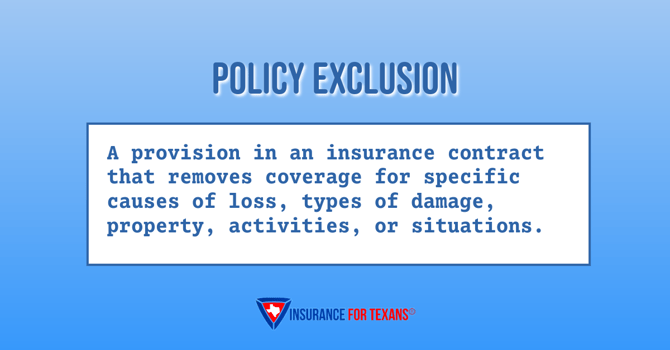
An exclusion tells you that a certain type of loss, cause of damage, property, or activity is not covered at all.
For example, your church may have a $2 million property limit. If a covered fire damages the building, that limit tells you how much coverage may be available. But if flood is excluded, the $2 million property limit does not matter when rising water damages the church. The loss has to be covered before the limit ever comes into play.
This distinction also matters when comparing insurance proposals. Two policies may have the same $2 million building limit but completely different exclusions. One may cover an exposure that the other removes. This is why the cheapest policy is not always the best value.
Evaluating Your Risk Exposure
An insurance policy can look strong on the front page and still leave your church exposed because of what is excluded deeper in the contract.
Through our True Texas Church Insurance program, we review those exclusions with you and explain where coverage may stop, what can be added back, and where a separate policy may be needed.
Our goal is not just to show you what your policy covers. It is to help you understand the situations where it may not respond at all.
Before your church chooses a policy based on price or coverage limits alone, let our team take a look at your policy.