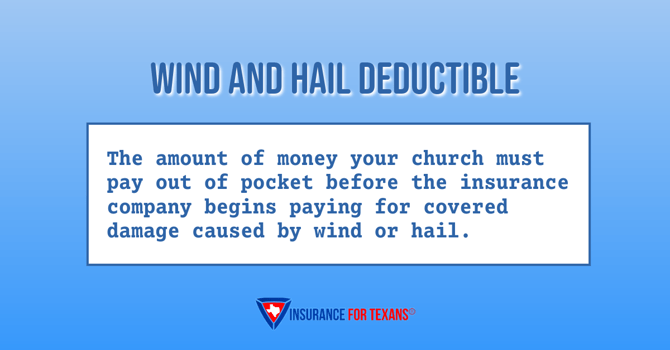
For most Texas churches, this deductible is different from the deductible used for other types of property claims. That matters because wind and hail losses are some of the most common and expensive property claims churches face in Texas.
The Hailstorm in Lubbock
Last spring, a hailstorm tore across Lubbock and pounded a local church for several minutes. When the storm passed, the church’s leaders walked around the outside of the building to survey the damage. The roof looked pretty battered and their gutters were dented. In addition, several HVAC units were hit and exterior surfaces showed obvious signs of hail impact.
The next day, they called a church member who owned a local roofing company. He inspected the roof and put together an estimate. After the church added estimates for the HVAC units and other exterior damage, the total came to about $150,000. Thankfully, the church carried $2 million in property coverage. The leaders felt confident that the policy would respond and that they could move forward with repairs.
Then they learned how their wind and hail deductible worked. The policy showed a 2% wind and hail deductible. At first, that did not sound like a very big number. But then their insurance agent explained that the 2% was not calculated on the $150,000 claim. It was calculated using the church property's $2 million insured value. This changed the calculations. 2% of $2 million came to $40,000.
The church’s leaders suddenly realized it would have to absorb the first $40,000 of the covered loss before the insurance company paid its portion. This is what catches many Texas churches off guard. A 2% deductible may look small on paper, but when that percentage applies to a multimillion-dollar property, the actual out-of-pocket cost can become very large, very quickly.
Why Are Texas Wind and Hail Deductibles So High?
Texas gets hit with a steady stream of hailstorms, severe thunderstorms, straight-line winds, and tornadoes. Those storms create a huge number of property claims every year.
As those losses have grown, insurance companies have looked for ways to keep property insurance available by controlling what they pay out after a storm. One of the biggest changes has been moving churches from smaller flat deductibles to larger percentage deductibles for wind and hail claims.
A flat deductible is a set dollar amount and applies to covered losses besides wind and hail. Wind and hail deductibles are percentage based deductibles. They are calculated using the insured value of your church's property.
Here are some examples of percentage based deductible amounts:
- 1% of a $1 million building equals $10,000
- 2% of a $2 million building equals $40,000
- 5% of a $3 million building equals $150,000
That is why a percentage deductible can be deceptive. The number itself may look small, but the actual amount your church has to absorb can be very large. A higher wind and hail deductible shifts more of the storm risk back to the church. In return, it may help keep the insurance premium lower than it would be with a smaller deductible.
The key is knowing what that percentage equals in dollars before a storm happens.
What Does Paying the Deductible Look Like After a Claim?
Suppose your church suffers $100,000 in covered hail damage and has a $25,000 wind and hail deductible. The insurance company does not pay the full $100,000. Your church is responsible for the first $25,000 of the covered loss. The insurance company then calculates its portion based on the remaining covered damage and the other terms of the policy.
And the deductible may not be the only amount your church has to absorb. If the policy also includes a roof payment schedule, actual cash value settlement, cosmetic damage exclusion, or another limitation, the final insurance pay out could be lower than the total repair bill.
This is why Texas churches need a church insurance expert on their side.
Is a Higher Deductible Always Bad?
A higher wind and hail deductible usually means your church agrees to keep more of the storm risk itself. In exchange, the insurance company may charge a lower annual premium. For some churches, that tradeoff can make sense. If your church has strong cash reserves and could comfortably handle a $50,000 deductible after a storm, paying less in premium every year may be worth taking on more of the loss yourself.
For another church, that same deductible could create a major financial problem. Saving money on the premium does not help much if the church cannot come up with the deductible when a hailstorm damages the roof. This is why the right deductible is not always the lowest one. You have to compare the annual premium savings against the amount of money your church would need to produce after a claim.
There are also other ways to manage that risk.
Some churches pair a higher wind and hail deductible with a standalone hail policy. These policies do not lower or buy down the deductible on the main property policy. Instead, they provide a separate cash payment when a qualifying wind or hail event occurs and the loss can be verified with weather data.That cash can give the church another source of money after a storm and may make a higher deductible easier to manage.
The goal is not simply to choose the smallest deductible available. It is to find the right balance between premium savings, the amount of risk your church can comfortably keep, and the protection you have in place when a storm actually happens.
Evaluating Your Church's Risk Exposure
A wind and hail deductible should never be treated like just a line item on an insurance proposal. In Texas, that percentage can turn into tens of thousands of dollars very quickly.
Through our True Texas Church Insurance program, we look at more than the premium. We show you what your wind and hail deductible equals in real dollars, how much risk your church is keeping, and whether that tradeoff makes sense for your budget.
Sometimes a higher deductible and lower premium can be a smart move. Other times, it leaves the church carrying more storm risk than it can realistically afford.
Before you choose a policy based on price, let our church insurance team take a look to make sure that your Texas church is properly covered.