
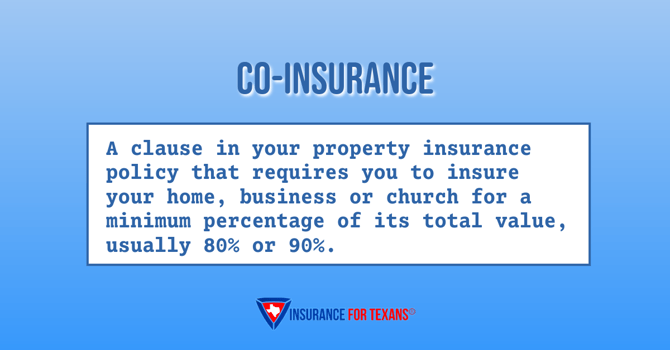
If you choose a coverage limit lower than this requirement, the insurance company will decrease a claim payout. Co-insurance is different from a copay.
An Expensive Mistake
A church in Midland owned a building worth $1 million. When church leaders reviewed their property insurance, they decided to insure the building for only $500,000 to keep the premium lower. They assumed that would still give them plenty of protection because they never expected to lose the entire building.
Then a small electrical fire caused $100,000 in damage. The church filed a claim expecting the insurance company to cover the repair cost, subject to the deductible. Instead, the policy’s 80% co-insurance requirement came into play. The church should have carried at least $800,000 in building coverage to meet that requirement. Because they only carried $500,000, the insurance company reduced the claim payment.
Instead of receiving the full $100,000, the church received only $62,500 before applying any other policy terms. This left them responsible for a much larger share of the repair bill than they were prepared to cover.
The Silent Clause in Texas Property
The Midland church’s situation is a nightmare that can stay hidden until the worst possible moment. In Texas, where property values are increasing faster than a West Texas windstorm, many business owners, homeowners and Texas churches are falling out of compliance with their co-insurance clauses without realizing it. If your building's value has gone up but your insurance limit stays the same, you may be dangerously underinsured.
How Co-insurance Actually Works
Think of co-insurance as a fair share agreement. The insurance company gives you a rate based on the idea that you are paying to insure the property for what it's actually worth.
The math they use during a claim looks like this:
- The Requirement: You must insure for at least 80% (or 90%) of the replacement value.
- The Check: If you are underinsured, they divide what you did carry by what you should have carried.
- The Penalty: That fraction is then applied to your claim.
Co-insurance formula: (Amount Carried / Amount Required) x Loss = Your Payout
Why It’s a Growing Risk in Texas
This is a major issue in growing markets like DFW, Austin, and Houston. As the cost of labor and building materials like lumber and steel goes up, the replacement cost of your building rises too. If you haven't adjusted your policy limits in the last two or three years, you might unknowingly be in violation of your co-insurance clause. You are essentially self-insuring a portion of every single claim without getting the benefit of a lower rate.
Here’s a stronger closing that fits the tone of the other church knowledge articles.
Evaluating Your Church's Risk Exposure
Co-insurance can create a major financial gap when your church carries less property coverage than the policy requires.
Through our True Texas Church Insurance program, we review your building values, policy limits, and co-insurance requirements to see whether your church carries enough coverage to avoid a reduced claim payment.
The goal is not simply to pick a property limit that keeps the premium low. It is to make sure that limit reflects what it would actually cost to rebuild your church today.