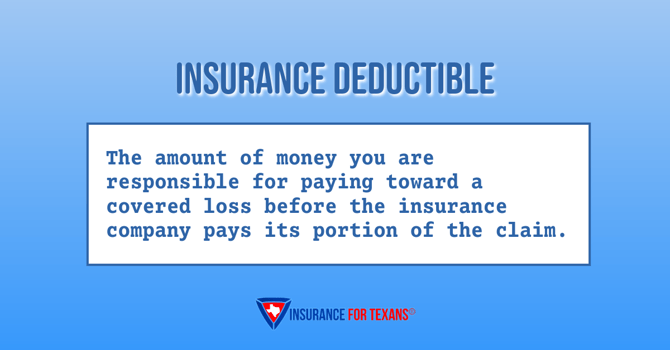
Deductibles are one of the most common ways insurance companies and policyholders share risk. You agree to handle the first part of a covered loss and the insurance company covers the rest up to the limits of the policy.
The Broken Pipe in Tyler
One night last winter, a plumbing line burst above the ceiling of a church office in Tyler. By the time the church administrator arrived the next morning, water had soaked the drywall, ruined part of the flooring, damaged office furniture, and reached several computers. Church leaders called a restoration company and started documenting the damage. After everything was inspected by the insurance adjuster, the covered loss came to about $35,000.
Thankfully, the church carried property insurance. Their deductible for water damage from a sudden pipe burst was $5000. This means that the insurance company expected them to pay the first $5000 of the claim and they would pay the rest.
A deductible is the part of a covered loss your church agrees to keep before the insurance company starts paying its share.
Different Deductibles Can Apply to Different Claims
A church insurance policy does not always have one deductible that applies to every claim. Many policies use different deductibles depending on what caused the loss. Your church might have a $5,000 deductible for a fire or plumbing loss, a 2% wind and hail deductible and a separate deductible for a named storm or certain types of water damage.
A flat deductible is a specific dollar amount. If your policy shows a $5,000 deductible, your church pays the first $5000 of the covered loss. A percentage based deductible works differently. The percentage is usually applied to the total insured value of your church’s property. If your church building is insured for $2 million and has a 2% wind and hail deductible, that deductible equals $40,000.
This is where churches can get caught off guard. A $5,000 deductible listed for one type of loss does not mean that the same deductible applies to every claim.
Higher deductibles may also help lower the annual premium because the church agrees to keep more of the risk. That tradeoff can make sense when the church has enough money available to absorb the deductible after a loss. It becomes a problem when the premium savings come with an out-of-pocket amount the church cannot realistically afford.
Deductible vs. Insurance Limit
A deductible and an insurance limit affect opposite ends of a claim. The deductible is the amount your church is responsible for first. The insurance limit is the maximum amount the insurance company will pay for the covered loss.
For example, if your church has a $10,000 deductible and a $1 million property insurance limit on the building, the church could have financial responsibility on both ends of a major claim. Your church pays the first $10,000 of a covered loss as the deductible. Then, if the total covered damage exceeds the $1 million building limit, your church is also responsible for the amount above that limit. That means a large claim can create out-of-pocket costs at both the beginning and the end of the loss.
When reviewing a church insurance policy, church leaders should understand which deductible applies to each type of loss, what any percentage deductible equals in real dollars, and whether the church could comfortably absorb that amount after a claim.
Evaluating Your Risk Exposure
Your church should not choose a deductible based on premium savings alone. The deductible represents the amount of a covered loss your church agrees to pay before the insurance company pays its share.
Through our True Texas Church Insurance program, we help church leaders compare both deductibles and premiums. We also put that deductible into real dollars for you and help you decide whether your church could comfortably handle that expense after a major claim.
A higher deductible may lower your annual premium, but the savings only make sense when your church can afford its share of the loss.