Cyber Liability Insurance protects a church from the liability and financial costs associated with data breaches, ransomware attacks, hacked accounts, online fraud, and other technology-related losses.
Depending on the policy, it may pay for computer investigations, data restoration, legal guidance, required notifications, business interruption, legal defense, and certain stolen funds.
Your Church Is Already a Digital Organization
Most church leaders are focused on ministry, not cybersecurity. With limited budgets and a small staff, it is easy to overlook how much the church now depends on technology and how that dependence can create new risks.
Texas churches use email, online giving, livestreaming, payroll software, child check-in systems, and membership databases every week. Those systems may store names, addresses, birthdays, giving records, banking information, background checks, prayer requests, counseling notes, and information about children and volunteers.
That data is valuable to criminals. One stolen password or compromised account can lead to stolen funds, locked computer systems, exposed personal information, and a serious interruption to the church’s mission.
Cyber Liability Insurance helps a church from having one hacked email address turn into a large financial nightmare.
The Email That Looked Completely Normal
A Texas church was halfway through renovating its children’s building when the church secretary received an email from the contractor. The message included the correct project name, the amount of the next payment, the contractor’s usual signature, and updated wiring instructions. At the time, nothing seemed unusual about the email. The church’s secretary did not notice that the wiring instructions were different than they had been before, so she sent the money.
Several days later, the actual contractor called to ask why the payment was late. This led the church to investigate and they found that someone had gained access to their email system, understood that the church was in the middle of a project and rerouted the payment to their account. The church immediately contacted the bank, but there was not much they could do. The money had already moved through several accounts and because it was authorized by a legitimate person at the church, the money was not recoverable.
This incident became a nightmare for the small Texas church. They had to determine if the church’s email system was compromised, what other data the criminals had access to and if anyone’s personal information was compromised.
This is why Cyber Liability coverage matters. Criminals do not always force their way through a complicated computer network. They have learned how to target smaller organizations, such as churches, who don’t think that this kind of attack could happen to them.
What Does Cyber Liability Insurance Cover?
Cyber Liability Insurance generally provides two types of protection: First-party and Third-party coverage. The exact coverage depends on the policy, but these are the typical ways that cyber liability works:
First-Party Cyber Coverage
First-party coverage helps pay for the church’s own recovery expenses.
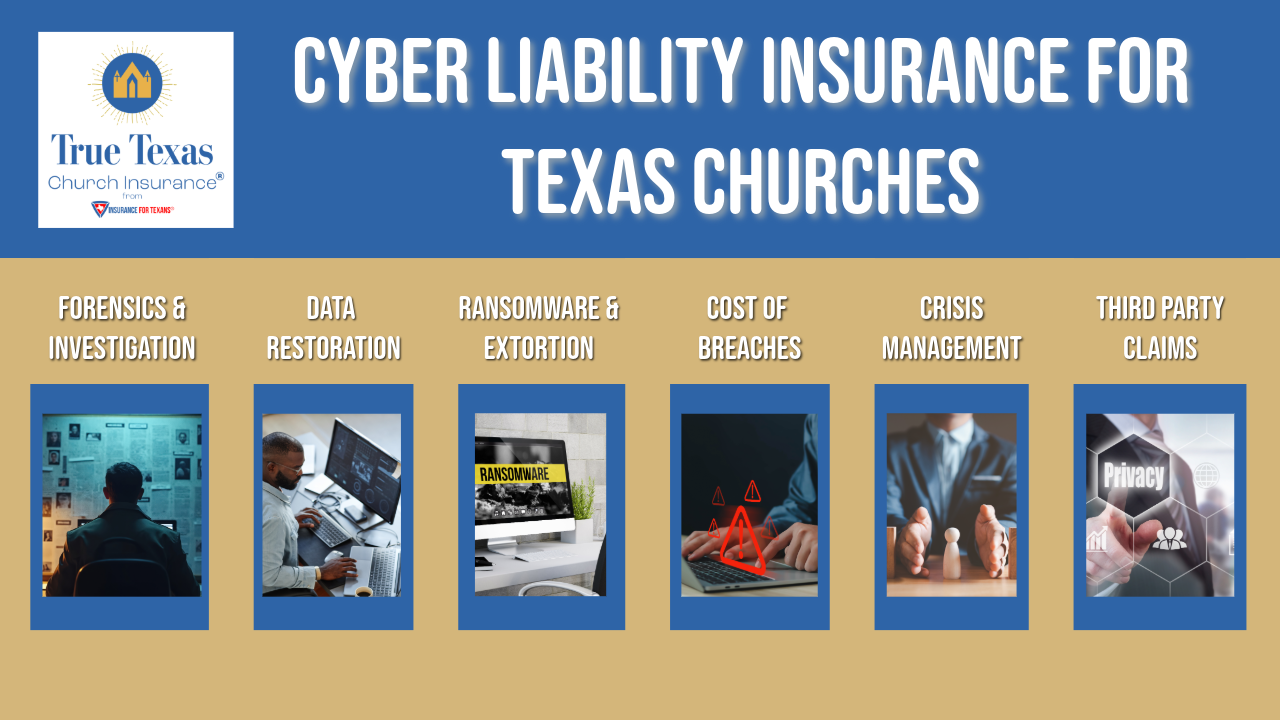
Computer Forensics and Investigation
When suspicious activity occurs, it generally takes some investigation to find the extent of the cyber breach.
A cyber policy pays for specialists to investigate the church’s computers, email accounts, cloud systems, and network. The investigation can help determine how the attacker entered, what information was affected, and what steps are needed to secure the systems.
Data and Software Restoration
Ransomware, malware, employee mistakes, and other cyber incidents can damage or delete important records.
Cyber coverage helps to restore giving histories, accounting files, membership records, employee information, sermon archives, photographs, and other electronic data. It may also help rebuild or restore damaged software and computer systems.
Ransomware and Cyber Extortion
Ransomware locks church leaders out of their files, email, accounting software, child check-in system, and other technology. Criminals often demand payment to restore access or threaten to release stolen information.
Cyber Extortion coverage pays for specialists who investigate the demand, communicate with the attacker, and help church leaders decide how to respond. It may also cover a ransom payment when legally permitted and approved by the insurance company.
Cyber Business Interruption
A cyberattack can interrupt church activities even when the church building remains open.
Staff may lose access to email, accounting records, donor information, online giving, payroll, livestreaming, or child check-in systems. A church-operated school or childcare program may also struggle to function without its records and technology.
Cyber Business Interruption coverage pays for certain lost income and extra expenses while the church restores its systems after a covered attack.
Breach Response Costs
When private information is exposed, the church may need legal advice, written notices, call center support, credit monitoring, identity protection, and public communication. First-party cyber coverage helps to pay those costs. It also provides access to a breach-response team that directs church leaders on what to do next.
Crisis Management
A data breach can damage trust that took years to build.
Church members may want to know what information was exposed, what the church is doing to correct the situation, and whether their families or finances are at risk. Cyber coverage provides public relations and crisis communication support to help church leaders respond clearly and responsibly.
Third-Party Cyber Liability Coverage
Third-party coverage responds when someone claims the church failed to protect information or prevent a cyber incident.
Privacy Claims
A member, employee, volunteer, donor, or parent may claim the church failed to secure their private information. Cyber coverage helps to pay legal defense costs, settlements and judgements connected to a covered claim.
Network Security Claims
A cyberattack generally extends beyond just the church itself. A compromised church email account could send malicious links to members, spreading malware or exposing systems to harmful software. The church may face liability for improperly secured systems. This coverage responds to those allegations.
Regulatory Investigations and Penalties
A data breach may create state or federal legal responsibilities. Depending on the information involved, the church may need legal counsel to respond to regulators, determine which laws apply, and document the steps it took after the breach. Cyber policies cover certain investigation costs, fines, or penalties.
Social Engineering and Funds Transfer Fraud
One of the most important parts of a cyber policy may also be one of the easiest to misunderstand.
Social Engineering Fraud occurs when a criminal deceives an employee into sending money or revealing information. The criminal may pretend to be the senior pastor, board chair, bank, contractor, missionary, or another trusted person.
Funds Transfer Fraud involves a criminal gaining unauthorized access to the church’s account or banking system and transferring money without permission.
These two losses may not be covered by a generic cyber liability policy. This is why Texas Church leaders need to seek out a church insurance specialist who can put together policies that cover their actual risks.
Here’s a stronger version that keeps your point about shared responsibility clear:
Churches Still Carry Cyber Risk
Many church leaders assume that third-party vendors, such as an online giving provider, carry all of the cybersecurity risk. While the vendor may be responsible for protecting its own platform and its insurance may respond first, that does not remove the church’s responsibility.
The giving provider may secure the payment transaction, but the church still controls its own email accounts, computers, accounting records, passwords, databases, and user access.
The church may also store names, addresses, giving histories, phone numbers, volunteer records, prayer requests, and information about children. A criminal does not have to break into the giving platform when a staff email account or administrator password gives them an easier way in.
Church leaders should understand which information the vendor stores, which information remains with the church, and what the vendor agreement requires after a breach.
The vendor’s insurance protects the vendor first. It does not automatically pay every expense, interruption, or claim the church may face because of the breach.
Texas Data Breach Responsibilities
A cyberattack is not only an information technology problem. It may also create legal responsibilities for the church.
Texas organizations that collect or maintain sensitive personal information must use reasonable procedures to protect it from unlawful use or disclosure. Sensitive personal information can include names combined with Social Security numbers, government identification numbers, financial account information, or certain health information.
When a qualifying breach occurs, affected individuals generally must be notified no later than 60 days after the organization determines that the breach happened.
The exact duties depend on the information involved and the facts surrounding the breach. Church leaders should contact the cyber carrier and qualified legal counsel quickly rather than deciding on their own whether notification is required.
Most Cyber Policies Are Claims-Made
Most Cyber Liability policies are written on a claims-made basis. The policy in effect when the claim is made generally responds, subject to the retroactive date, reporting requirements, and other policy terms.
The Retroactive Date
The retroactive date determines how far back the policy may reach for cyber incidents that later create a claim. A breach may go unnoticed for months. If the unauthorized access began before the retroactive date, coverage may be limited or unavailable.
When changing insurance companies, Texas church leaders should protect the church’s existing retroactive date whenever possible.
Reporting Requirements
Some cyber policies are written on a claims-made-and-reported basis. The church may have to report the claim or suspected circumstance within the policy period or another stated deadline.
A ransomware demand, stolen laptop, suspicious account login, fraudulent transfer, or vendor breach should be reported promptly. Church leaders should not wait until a lawsuit is filed or every detail is known.
Extended Reporting Period
An Extended Reporting Period may give the church additional time to report certain claims after the policy ends. It generally applies only to incidents that occurred before the old policy expired. It does not cover new cyber events that happen after coverage is canceled.
Understand the Cyber Limits and Sublimits
Cyber liability policies have limits or sublimits on specific types of breaches. As a church leader, you should review the limits of your specific policy with your church insurance agent.
- The overall Cyber Liability limit
- The deductible or retention
- The Social Engineering limit
- The Funds Transfer Fraud limit
- The ransomware or Cyber Extortion limit
- The Business Interruption limit
- The waiting period for an interruption claim
- The data restoration limit
- The breach response limit
- The regulatory defense limit
- Whether defense costs reduce the limit
- The retroactive date
- The reporting deadline
Cyber policies are highly customized, and different coverages may carry separate limits, waiting periods, and conditions.