Skip to content
True Texas Church Insurance - Original

Texas Church Commercial Auto Insurance

Commercial Auto Insurance protects a church when its vehicles are involved in an accident. In general, it covers injuries and property damage caused to others, legal defense costs, damage to church-owned vehicles, medical expenses, and losses caused by uninsured or underinsured drivers.

Coverage can also be added for vehicles the church rents, borrows, or does not own.

Church Transportation Is A Risk

Church-owned vehicles support many parts of the church's mission. They may transport youth to camps and activities, carry volunteers to mission sites, or help the church serve people through community outreach.

While not all churches own their own vehicles, many rent or borrow vehicles for occasional trips or ministry opportunities. And some churches ask employees or volunteers to use their personal vehicles for church purposes.

All of these things are an important part of the life of a church, but they also create risk.

Commercial auto insurance is designed to protect the church from the liability associated with owning and using vehicles.

The Youth Trip That Ended Badly

A small church in Abilene sent its youth group to a week-long retreat in New Mexico. Each year, a group of students goes on this trip to spend time outdoors, grow closer as a group, and deepen their relationship with the Lord.

On the drive home last summer, the youth pastor was behind the wheel of one of two church vans carrying the students. Shortly after crossing back into Texas, the group reached a construction zone where traffic slowed and the lanes narrowed.

The youth pastor was watching the road, but the drivers ahead suddenly hit their brakes when they realized their lane was ending. He could not stop the van in time and rear-ended the vehicle in front of him.

When he stepped out to check the damage, he saw that the van was badly damaged. In addition, several students were also complaining of neck pain. This is where commercial auto insurance enters the scene to protect the church from the liability, medical bills and repairs associated with an accident like this.

What Does Commercial Auto Insurance Cover?

Commercial auto insurance is a policy that combines several types of protection into one policy.

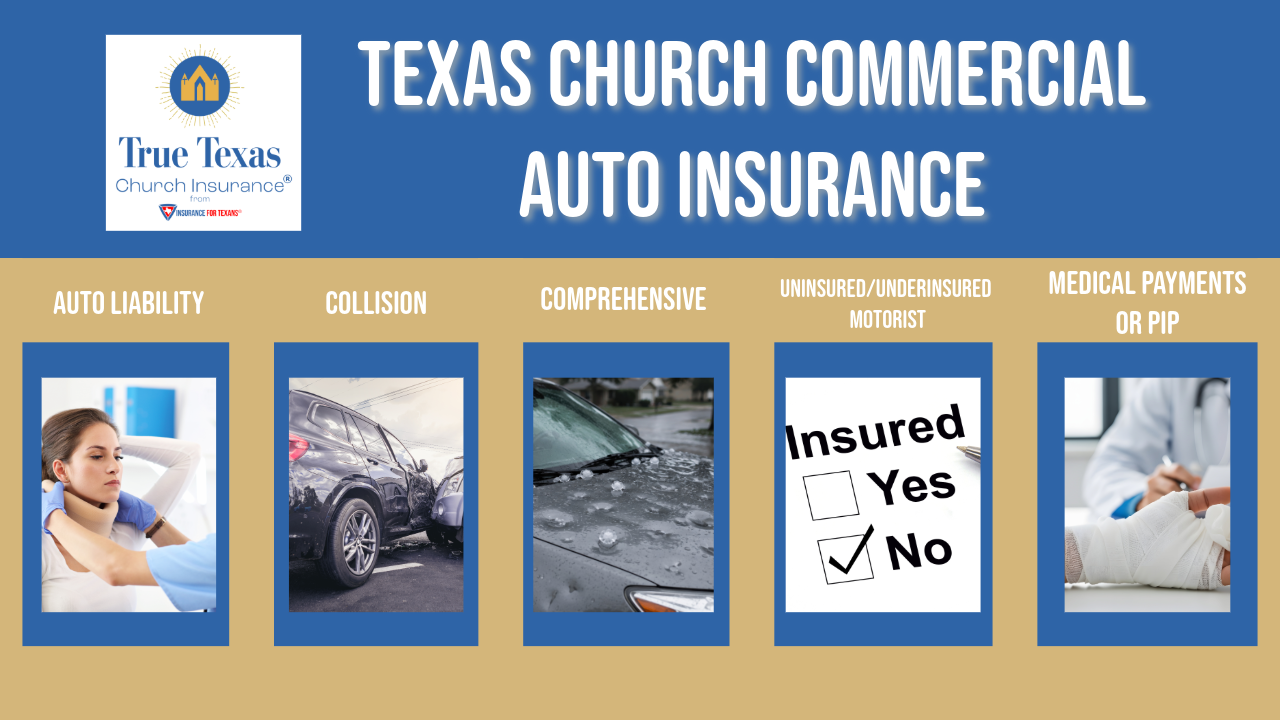
Auto Liability Coverage

Liability coverage protects the church when an insured driver causes an accident that injures a third party or damages their property. This liability protection includes covering the person’s medical expenses and vehicle repairs. It also covers the church’s legal defense costs, settlements and judgements should an accident result in a lawsuit.

Texas law requires drivers to have a way to pay for accidents they cause. The state’s minimum auto liability requirement is $30,000 for injury to one person, $60,000 for injuries in one accident, and $25,000 for property damage. Those minimum limits can be exhausted quickly in an accident involving several passengers or expensive vehicles.

Collision Coverage

Collision coverage pays to repair or replace a covered church vehicle after an accident. It also covers repairs if the vehicle collides with another object or overturns. For example, collision coverage responds when a church van strikes another car, hits a guardrail, or rolls during an accident. After the deductible is paid, the insurance company covers the rest of the damages.

Comprehensive Coverage

Comprehensive coverage is also known as other than collision coverage. It covers perils such as theft, vandalism, hail, fire, falling objects, flooding, or damage caused by an animal. The covered causes of loss and deductible depend on the policy.

Uninsured and Underinsured Motorist Coverage

Uninsured and underinsured motorists do not carry enough automobile coverage in order to pay for the damages that they cause in an accident. Uninsured or underinsured motorist coverage protects the church from the responsibility of paying for damages after colliding with an inadequately covered driver. This coverage is a required part of commercial auto policies in Texas. You may reject it, but you have to do so in writing.

Personal Injury Protection and Medical Payments

Personal Injury Protection, commonly called PIP, pays certain medical expenses and lost income after an accident regardless of who caused it. Medical Payments coverage also pays certain medical or funeral expenses for occupants of a covered vehicle. The limits are usually much lower than the policy’s auto liability limit.

Hired Auto Coverage

Hired Auto Liability can be added to a commercial auto policy or to the church’s general liability policy if they don’t own vehicles. This coverage will protect the church from the liability associated with an accident that happens in a hired, rented or leased vehicle.

A church may rent a van for a youth retreat, lease a vehicle during a mission trip, or hire a bus for a special event. The church could be named in a lawsuit if an accident occurs while the vehicle is being used for its activities.

Non-Owned Auto Coverage

Non-Owned Auto Liability helps protect the church from liability when an employee or volunteer uses a personal vehicle for church business. It can be added to the commercial auto policy or the church’s general liability coverage.

Church employees and members may use their personal vehicles for church-related activities. For example, a youth minister might drive a student home after youth group or the missions pastor may take a church member to a medical appointment as part of a church outreach program.

The vehicle owner’s personal auto policy responds first to cover the driver and the vehicle. Non-Owned auto coverage provides additional liability protection for the church if it is named in a lawsuit arising from someone using their personal vehicle for church business.

Personal Auto Insurance Is Not Enough

Some small churches try to title a church vehicle in the pastor’s name or place it on a personal auto policy to avoid commercial insurance rates. That can create a serious coverage problem.

Personal auto policies are designed for an individual or family, not a church vehicle used by a changing group of pastors, employees, deacons, and volunteers. If an unlisted driver causes an accident, the insurance company may question whether the vehicle’s ownership and use were accurately represented.

A personal policy also focuses on protecting the named owner and driver. It is not designed to protect the church when the organization is named in a lawsuit. Church buildings, bank accounts, and other assets may be exposed if the church does not have the proper commercial auto coverage.

Church-owned vehicles should be titled and insured in the church’s name. Keeping church property and liability separate from a pastor’s personal insurance is a basic part of good risk management.

Texas Church Commercial Auto Insurance Web Page

General Liability Insurance Is Not Enough

Church general liability insurance is designed to protect the church from the liability associated with claims of bodily injury or property damage that occur at the church. While hired and non-owned auto coverage can be added to the general liability policy, the policy itself will not cover vehicles that are owned by the church.

Commercial auto insurance is specifically designed to cover church owned vehicles as well as hired and non-owned auto exposures.

Who Is Allowed to Drive?

A Commercial Auto policy does not automatically allow every employee, member, or volunteer to drive a church-owned vehicle. Insurance companies often have requirements based on the driver’s age, driving record, experience, and the type of vehicle being used.

The church should also maintain a written driver approval process. Before allowing someone to drive, church leaders should confirm that the person has a valid license, an acceptable driving history, appropriate experience, and the physical ability to operate the vehicle safely.

Motor vehicle records should be reviewed before approval and again on a regular schedule. Approved drivers should also receive training on passenger loading, backing, breakdowns, emergency procedures, distracted driving, and the handling differences between cars, vans, buses, and vehicles pulling trailers.

Large Vans and Buses Require Extra Attention

A church van or bus does not handle like a normal passenger car.

Federal guidance states that a church driver needs a Commercial Driver’s License when operating a vehicle designed to transport 16 or more people, including the driver. Additional transportation rules may apply based on the vehicle, its weight, the number of passengers, and whether the church travels across state lines.

Church leaders should review licensing, inspection, maintenance, driver qualification, and travel requirements before using a large passenger vehicle.

Fifteen-Passenger Vans Carry Unique Risks

A church finance committee may see a used 15-passenger van as an affordable transportation option. The purchase price may be low, but the long-term insurance cost and safety concerns can make it far more expensive than expected.

Many insurance companies are reluctant to cover 15-passenger vans because of their higher center of gravity and rollover risk. Some carriers may refuse to insure them, while others may require the church to remove the back row of seats or meet additional driver and safety requirements.

Before buying one, the church should price the insurance and review the carrier’s requirements. A small shuttle bus with dual rear wheels may cost more upfront, but it can be safer and easier to insure over time. For churches that transport people regularly, it may be the better long-term investment.

Church-Owned Vehicles Need Regular Maintenance

A church vehicle may sit unused for days or weeks between trips. That does not mean it remains ready to safely transport passengers.

Tires can lose pressure, batteries can weaken, fluids can leak, and mechanical problems can go unnoticed. The church should assign responsibility for maintenance instead of assuming someone else is checking the vehicle.

Each vehicle should have documented repair and maintenance records. Drivers should complete a basic inspection before each trip, including tires, lights, mirrors, brakes, seat belts, emergency equipment, and visible damage.

Problems should be corrected before the vehicle carries passengers.

Loaning Church Vehicles is Risky

A local nonprofit, member, or another church may ask to borrow the church van or bus.

Helping may seem like a simple act of generosity, but the church loses control over who drives, how the vehicle is used, how passengers are supervised, and whether the other organization follows the same safety standards.

The church’s policy may limit or exclude certain uses by outside organizations. Church leaders should avoid vehicle loans whenever possible. If allowed, they need to use a written agreement requiring separate insurance before the vehicle leaves the church’s parking lot.

The church should speak with its insurance agent and attorney before allowing another organization to use its vehicle.

Commercial Auto and Umbrella Coverage Work Together

A serious accident involving several passengers can create claims that exceed the commercial auto liability limit.

Commercial umbrella insurance provides additional limits over covered Commercial Auto and General Liability claims. Church leaders should confirm that every church vehicle and auto exposure is included under the umbrella policy. The umbrella may also require the church to maintain certain underlying auto limits.

Understand Your Commercial Auto Policy

Commercial Auto policies can contain important gaps that are not obvious from the declarations page. Covered vehicles, approved drivers, Hired and Non-Owned Auto, physical damage, passenger protections, trailers, and Umbrella coverage all need to match how the church actually uses its vehicles.

An experienced church insurance agent can review those details, identify missing coverage, and help the church avoid surprises after an accident.

Common Exclusions

Commercial Auto policies vary, but most policies exclude:

  • Vehicles that were never reported
  • Drivers who do not meet the carrier’s requirements
  • Use by an outside organization
  • Transporting people for a fee
  • Damage to a rented vehicle without physical damage coverage
  • Personal property or ministry equipment inside the vehicle
  • Mechanical breakdown, wear, or poor maintenance
  • Intentional or criminal conduct
  • Racing or other prohibited activities
  • Accidents outside the policy’s coverage territory
  • Failure to comply with licensing or vehicle-use requirements

Church leaders should review their policy to make sure that they know if every driver, vehicle, trailer, or trip is protected.

Written Protocols Matter

Commercial Auto Insurance can respond after an accident, but clear transportation rules may help prevent one. Churches should approve drivers, review driving records, verify personal insurance, require seat belts, prohibit distracted driving, and train each driver for the vehicle they use.

Church leaders should also document maintenance, complete pre-trip inspections, plan routes, monitor weather, and maintain emergency procedures. A safe vehicle still depends on a qualified driver and a consistent process for keeping it road-ready.

What Should the Church Do After an Accident?

The driver should first check for injuries and contact emergency services when needed.

The church should then notify its insurance company, document the scene, exchange information with the other parties, identify witnesses, and preserve photographs or video. The driver should not admit fault or promise that the church will pay a claim.

Leadership should also review whether parents, board members, legal counsel, or other church leaders need to be contacted. Serious accidents should be handled through a written response plan rather than rushed decisions made from the side of the road.

Texas Churches Need a Church Insurance Specialist

A generic commercial insurance agent may understand vehicles and drivers, but church transportation creates risks that are different from those of an ordinary business. Youth trips, volunteer drivers, rented vehicles, passenger vans, and ministry travel all affect how the policy should be written.

A church insurance specialist understands those differences and knows which carriers are willing to cover them. True Texas Church Insurance helps church leaders to identify coverage gaps and build a Commercial Auto policy around the way the church actually uses its vehicles.

Protect Your Texas Church

Church transportation allows people to worship, learn, serve, travel, and participate in ministry when they might not otherwise have the opportunity.

It also places the safety of every passenger in the hands of the church.

Do not wait until an accident reveals that a volunteer’s personal policy was expected to carry the risk, a rented van had no physical damage protection, or the church never purchased Non-Owned Auto coverage.

True Texas Church Insurance helps Texas church leaders understand their Commercial Auto limits, covered vehicles, approved drivers, Hired and Non-Owned Auto risks, and passenger safety responsibilities. Through our personalized risk assessment, we replace assumptions with a clear strategy for protecting the people, vehicles, and ministry traveling down the road.

Click the button below to schedule a policy review with our church insurance experts.

Click To Cover Your Church!


True Texas Church Insurance Process

Step One: Understand the Transportation Risk

We review every vehicle, trailer, driver, passenger program, transportation ministry, and related legal entity. We also look at rented vehicles, personal vehicles used for church activities, schools, childcare programs, camps, mission trips, driver screening, vehicle maintenance, and prior accidents.

Step Two: Build the Commercial Auto Strategy

We compare Auto Liability limits, Collision and Comprehensive coverage, deductibles, Uninsured and Underinsured Motorist protection, Hired Auto, Non-Owned Auto, rental vehicle protection, and Umbrella coverage. We also review how Commercial Auto works with the church’s other policies. Our goal is to account for every reasonable way the church moves people and property.

Step Three: Present the Church to Insurance Companies

We explain how the church selects drivers, reviews driving records, trains volunteers, maintains vehicles, plans trips, and protects passengers. Not every insurance company evaluates church transportation the same way. Our job is to find carriers that understand ministry vehicles and explain the real differences between the available options.

Why Texas Churches Turn To True Texas Church Insurance

300+
Churches Trusted By True Texas Church Insurance
600+
Churches Helped In Some Way By True Texas Church Insurance
The Promise Of Certainty

We Wrote The Book On Texas Church Insurance

  • Real Stories About Texas Churches
  • Practical Advice For Church Leaders
  • Our Three Step Process
  • Why Coverage Matters
  • Your Guide To Certainty

What Texans Have To Say About Our Process

Are You Ready To Protect Your Church?