Directors and Officers Liability Insurance, commonly called D&O, helps protect a church and its leaders when someone claims that a management or governance decision caused financial harm. Depending on the policy, it may pay legal defense costs, settlements, and judgments arising from covered allegations against the church, its board members, officers, pastors, and other leaders.
Church Leadership Decisions Can Create Personal Risk
Church board members make decisions that affect property, finances, employees, ministries, membership, and the future direction of the church.
Most leaders accept that responsibility because they care deeply about the church. They are not expecting to be personally named in a lawsuit because of a vote they made during a board meeting.
But good intentions do not prevent someone from challenging the decision. A donor, employee, member, vendor, or another organization may claim leadership acted improperly, violated the bylaws, mismanaged money, or exceeded its authority.
D&O Insurance provides financial protection when a covered leadership decision becomes a legal dispute.
The Property Sale That Became a Board Lawsuit
A Texas church owned an education building it had not used in several years. Repairs were becoming expensive, so the board voted to sell the property and use the proceeds to strengthen the church’s other ministries.
Several members disagreed with the decision. They claimed the church’s bylaws required a vote of the congregation before property could be sold.
The members filed a lawsuit seeking to stop the sale. The claim named the church, chairman of the board, treasurer, and senior pastor. The members alleged that leadership exceeded its authority and failed to follow the church’s governing documents.
The board believed it had acted in the church’s best interest. But vague meeting minutes and conflicting versions of the bylaws made the situation harder to defend. The church still needed an attorney to respond to the lawsuit, review years of records, and defend each leader who had been named.
That is why D&O Insurance matters. Even when church leaders act carefully, honestly, and in the church’s best interest, someone may still challenge the decision and force the church to defend it.
What Does Church D&O Insurance Cover?
Directors and officers liability insurance safeguards pastors, elders, and trustees against governance disputes.
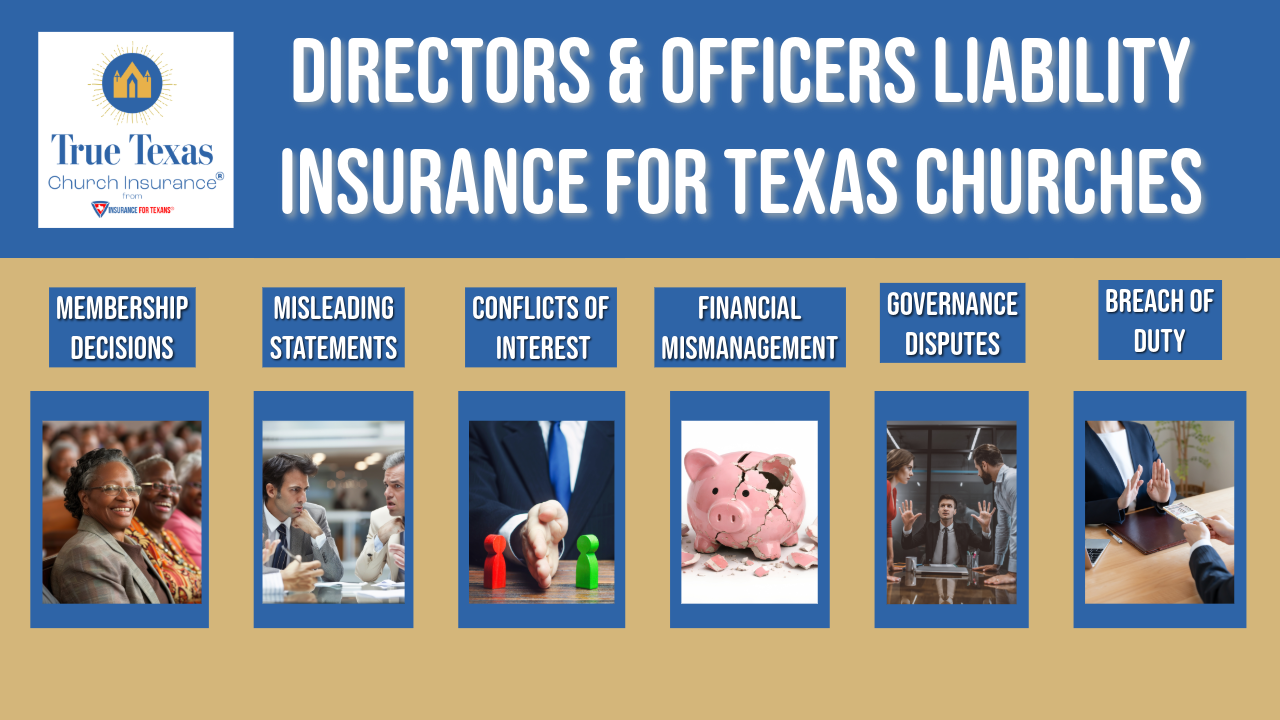
Governance disputes may include an actual or alleged error, omission, misleading statement, neglect, or breach of duty. The exact definition depends on the specific policy’s language.
Breach of Duty
Board members and officers may be accused of failing to meet their responsibilities to the church.
Texas nonprofit directors are expected to act in good faith, exercise ordinary care, and make decisions they reasonably believe are in the church’s best interest. A director who meets those standards generally receives protection under state law, but someone can still file a claim and force the leader to defend those actions. .
Bylaw and Governance Disputes
Church bylaws explain how leaders are selected, who has authority to make decisions, how meetings are conducted, and when members must approve an action.
A lawsuit may claim the board failed to follow those rules when selling property, removing a leader, changing the governing structure, closing a ministry, or making another major decision.
Financial Mismanagement
A donor or member may claim that leaders mishandled church money, failed to protect restricted donations, approved an improper transaction, or did not provide appropriate financial oversight.
Texas nonprofit law specifically recognizes the board’s responsibility to safeguard restricted funds for their intended purposes.
Conflicts of Interest
A conflict may arise when a board member has a personal or financial interest in a decision before the church.
For example, the church may consider hiring a construction company owned by a board member or leasing property from a pastor’s relative. The transaction may be reasonable, but it can still create questions if the conflict was not disclosed and handled properly.
Misrepresentation
A donor, lender, member, or another party may claim a church leader made a misleading statement about the organization’s finances, property, fundraising campaign, or plans.
Even if the statement was made accidentally or based on incomplete information, the church would still need to defend itself against the allegation.
Claims Involving Membership Decisions
Disputes may arise from membership status, church discipline, voting rights, leadership removal, or access to church records.
Churches have important constitutional protections concerning internal religious decisions. However, those protections do not stop someone from filing a lawsuit or eliminate the cost of establishing that the dispute belongs outside the civil courts.
Legal Defense Costs
When disputes arise and lawsuits are filed, the church needs to hire an attorney to defend itself against these claims. Even if they are ultimately found to be innocent of the allegations, they still need to go through the legal process. This gets expensive and is one of the most important reasons why directors and officers liability insurance is an important coverage.
In addition, these policies pay for judgments and settlements if the church is found liable for the charges against them. As with other liability policies, Texas church leaders need to review their specific policy to understand whether defense costs are inside or outside of the policy’s limits.
Who Does the D&O Policy Protect?
A church D&O policy may protect more than the people serving on the board.
Depending on the policy, insured people may include:
- The church as an organization
- Current and former board members
- Trustees, elders, deacons, and officers
- Pastors and executive leaders
- Committee members
- Employees acting in a leadership role
- Volunteers making decisions on behalf of the church
- Spouses or estates of insured leaders in limited situations
Not every title is treated the same way by every carrier. Texas church leaders should review their policy’s definition of an insured person rather than assuming everyone connected to the church is included.
Separate legal entities also matter. A school, foundation, childcare center, or outreach organization may not be covered merely because it shares the church’s campus, leadership, or name.
Protecting Both the Leader and the Church
A strong nonprofit D&O policy provides several layers of protection.
Individual Leader Protection
The policy protects board members, officers, pastors, or other insured leaders when the church cannot legally or financially reimburse that person for a covered claim.
This protection matters because a lawsuit may name individual leaders along with the church.
Reimbursement to the Church
Church bylaws may allow or require the organization to indemnify a leader who is sued because of their service.
D&O coverage reimburses the church for covered legal expenses and damages it pays on the leader’s behalf.
Protection for the Church Entity
Many nonprofit D&O policies also protect the church itself when it is named in a covered management claim. Entity coverage is important because lawsuits often name both the organization and its individual leaders.
Texas Law Does Not Eliminate the Need for D&O Coverage
Texas law provides important standards and protections for nonprofit directors and officers.
A director is expected to act in good faith, with ordinary care, and in a manner reasonably believed to be in the best interest of the organization. Religious corporation directors may also rely in good faith on certain information or opinions provided by trusted religious authorities or ministry leaders. These protections can provide a strong legal defense, but they do not prevent someone from making an allegation or naming the leader in a lawsuit.
D&O Insurance helps pay the cost of proving that leadership acted properly.
Most D&O Policies Are Claims-Made
D&O Insurance is commonly written on a claims-made basis. This means the policy in effect when the claim is first made generally responds, subject to the retroactive date and other policy requirements. Some policies are written on a claims-made-and-reported basis. The claim must be made against the church and reported to the insurance company within the required period.
The Retroactive Date
The retroactive date determines how far back the policy may reach for leadership decisions that later produce a claim.
For example, a claim made today may involve a board decision from several years ago. If that decision occurred before the retroactive date, the policy may not respond.
When changing carriers, Texas church leaders should protect the church’s existing retroactive date whenever possible.
Extended Reporting Period
An Extended Reporting Period may allow the church to report certain claims after a claims-made policy ends.
It generally applies only to wrongful acts that occurred before the prior policy expired. It does not cover new decisions made after the policy ended.
Reporting Known Circumstances
A demand letter, threat of legal action, disputed board vote, attorney communication, or serious complaint may need to be reported before a lawsuit is filed.
Church leaders should notify their agent or insurance company quickly rather than waiting to see whether the disagreement goes away.
Understand Policy Limits
Limits of insurance are always important to review with any insurance policy. Every policy is different and has specific listed coverage limits.
This review should include:
- The limit for each claim
- The total aggregate limit
- The deductible or retention
- Whether defense costs reduce the limit
- The retroactive date
- Reporting deadlines
- Who qualifies as an insured
- Which legal entities are included
- Whether prior leaders are covered
- Whether an Umbrella policy applies
Many D&O policies include defense costs within the limit. Every dollar spent on attorneys may reduce the amount available for a settlement or judgment.