Skip to content
True Texas Church Insurance - Original

Texas Church Employment Practices Liability Insurance

Employment Practices Liability Insurance, commonly called EPLI, helps protect a church when a current employee, former employee, or job applicant claims the church violated their workplace rights. Depending on the policy, it may pay legal defense costs, settlements, and judgments connected to wrongful termination, discrimination, harassment, retaliation, and other covered employment claims.

Churches Are Employers 

Churches are built around relationships, trust, and a shared mission. Employees often worship beside the people they work with, serve under pastors they respect, and view their coworkers as part of a church family.

That closeness is one of the strengths of a church family. It can also make difficult employment decisions harder to handle.

Church leaders may use pastoral conversations instead of written warnings. A staff member’s responsibilities may change without an updated job description. A termination may be handled kindly but without documentation explaining what led to the decision.

The church may never intend to mistreat anyone. But once it hires employees, it also becomes an employer with legal, financial, and management responsibilities.

The Reorganization That Became a Lawsuit

A smallTexas church decided to reorganize its staff after attendance and giving changed over several years. The church’s leaders decided to eliminate a longtime administrative position and combine those duties with others to create a new position.

In the process, the former employee felt like the church used the facade of a reorganization in order to replace her with someone younger and of the opposite gender. She filed a claim alleging age and sex discrimination.

Church leaders believed they had made a reasonable decision for the future of the church. The problem was that they had not documented anything leading up to the change. There were no current job descriptions, written performance reviews, board minutes, or other records showing why the position changed.

In order to defend themselves against these allegations, the church had to hire an attorney to respond, gather documents, and defend its decision. Even if the church ultimately proved that it acted legally, defending themselves could cost tens of thousands of dollars.

This scenario is why EPLI matters. Good intentions may shape how church leaders treat an employee, but they do not prevent someone from filing a claim.

What Does EPLI Cover for a Texas Church?

EPLI is designed for claims arising from the employment relationship. The exact protection depends on the policy, but commonly, these policies respond to different allegations.

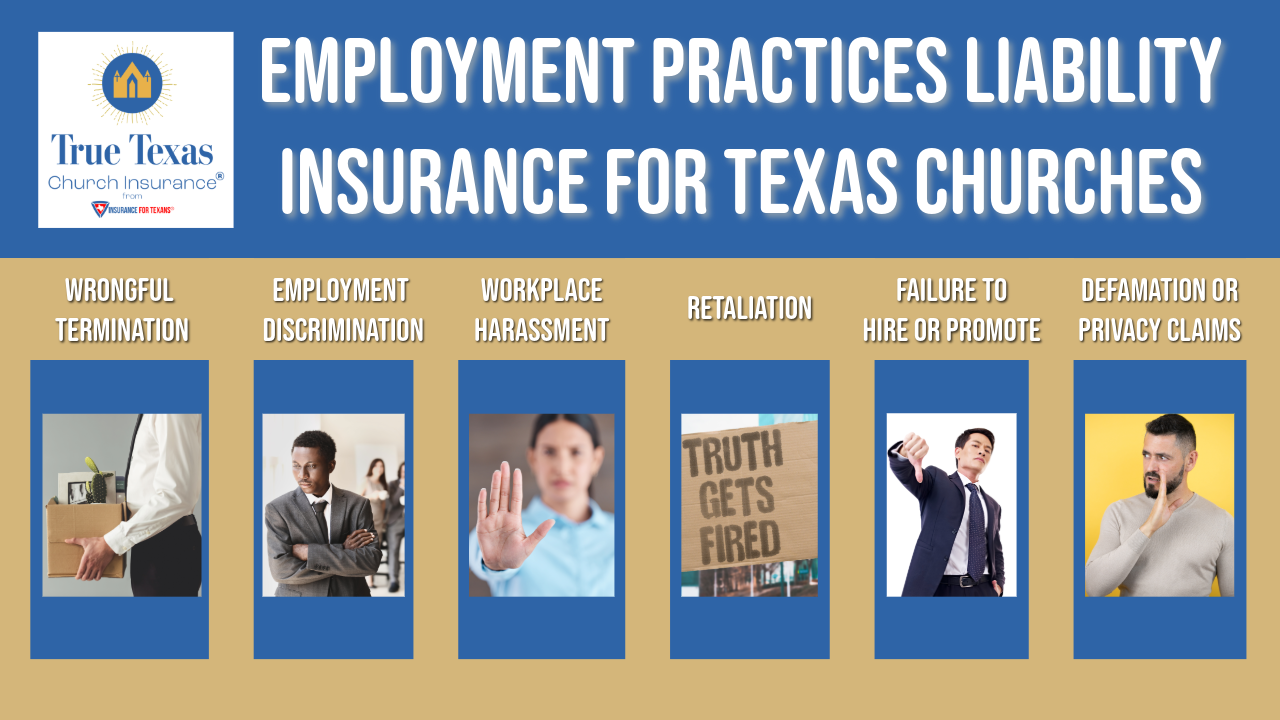
Wrongful Termination

A former employee may claim the church fired them for an illegal reason or failed to follow its own employment procedures.

The church may believe the employee was not performing well or no longer fit the ministry’s direction. Without written expectations, performance records, or a clear reason for the decision, leadership may have difficulty proving what happened.

Employment Discrimination

An employee or applicant may claim the church treated them differently because of age, race, color, sex, national origin, disability, or another protected characteristic. Some discrimination claims depend on the number of employees that the church has.

Churches also need to consider Texas and local employment laws, which may apply differently or reach smaller employers.

Workplace Harassment

EPLI may respond to allegations of sexual harassment, hostile workplace conduct, or other covered harassment involving pastors, supervisors, coworkers, or other people connected to the church.

Texas sexual harassment law can apply to an employer with one or more employees. It defines sexual harassment to include certain unwelcome sexual conduct that affects employment or creates an intimidating, hostile, or offensive workplace.

That means a church should not assume it is too small to face a workplace harassment claim.

Retaliation

An employee may claim the church punished them for reporting discrimination, harassment, financial concerns, safety problems, or another workplace issue.

Retaliation does not always involve termination. It may include a demotion, reduced hours, reassignment, exclusion from meetings, or another negative employment action.

Failure to Hire or Promote

A job applicant may claim the church refused to hire them for an unlawful reason. A current employee may allege that discrimination affected a promotion, pay increase, ministry opportunity, or leadership position.

Hiring decisions should be based on written qualifications and applied consistently. The church should document why one candidate was selected over another.

Employment-Related Defamation and Privacy Claims

Some EPLI policies may cover allegations involving employment-related defamation, invasion of privacy, or improper disclosure of employee information.

For example, a former employee may claim that church leaders made damaging statements about why they were terminated. Another employee may allege that private medical or personnel information was shared with people who had no reason to receive it.

Coverage depends heavily on the policy language, exclusions, and how the claim is presented.

Churches Have Some Legal Protections

Churches have important constitutional and legal protections when making certain employment decisions. However, those protections do not mean every church employee or every workplace dispute falls outside employment law.

The Religious Organization Exemption

Federal law allows qualifying religious organizations to prefer employees who share their religion. That protection recognizes the church’s right to preserve its beliefs and religious identity.

However, the exemption generally addresses decisions based on religion. It does not automatically exempt a church from claims involving race, sex, national origin, disability, age, or other protected characteristics.

Church leaders should clearly document the religious qualifications for each position and apply those qualifications consistently.

The Ministerial Exception

The ministerial exception protects a religious organization’s right to select and manage certain employees who perform important religious duties.

The protection is not limited to someone with the title of pastor. Courts may look at the employee’s actual responsibilities, religious training, role in teaching the faith, leadership in worship, and importance to the church’s religious mission. The U.S. Supreme Court has rejected using one rigid test for every position.

A senior pastor may clearly fall within the exception. The answer may be less obvious for a worship leader, schoolteacher, counselor, administrator, or ministry director.

Legal Defense Still Costs Money

The religious organization exemption and ministerial exception are legal defenses. They do not prevent a former employee from filing an administrative charge or lawsuit.

The church may still need an attorney to demonstrate that an exemption applies. That process can require employment records, job descriptions, ministry documents, witness interviews, and extensive legal work.

EPLI helps provide the financial resources to defend the church when a covered claim challenges one of its employment decisions.
EPLI for Texas Churches Website Image

General Liability Doesn't Replace EPLI

Church General Liability Insurance primarily responds to certain claims involving bodily injury, property damage, and personal or advertising injury. It is not designed to cover most disputes between the church and its employees.

Wrongful termination, discrimination, harassment, and retaliation normally require Employment Practices Liability coverage. A church can have strong General Liability limits and still have little or no protection for an employment claim.

EPLI may be written as a separate policy. Some church insurance policies may offer it through an endorsement with lower limits or narrower terms. Texas church leaders need to review the actual coverage terms instead of assuming that EPLI is automatically included.

Understand Who the Policy Protects

An EPLI policy may protect the church as an organization along with certain pastors, directors, officers, supervisors, and employees. It may respond to claims from current employees, former employees, and job applicants.

Coverage for temporary workers, seasonal employees, volunteers, independent contractors, and employees of separate church-operated organizations can vary.

For example, a church may operate a school under a different legal name. If that school and its employees are not included within the EPLI policy, a claim involving a teacher or administrator could create a coverage problem.

Most EPLI Policies Are Claims-Made

Many EPLI policies are written on a claims-made basis. This means the timing of the claim and the date it is reported to the insurance company can affect whether coverage applies.

Texas church leaders should pay attention to:

The Retroactive Date

The retroactive date determines how far back the policy may reach for acts that later lead to a claim. An employment action that happened before that date may not be covered.

Changing carriers or allowing a policy to lapse can create a gap if the new coverage does not preserve the church’s prior acts date.

The Reporting Requirement

A church may be required to report a claim or known circumstance during the policy period or within a limited reporting window.

A demand letter, EEOC notice, attorney communication, or employee threat may need to be reported even when no lawsuit has been filed. Church leaders should notify their insurance agent or carrier promptly instead of waiting to see whether the problem goes away.

Defense Costs

Defense expenses often reduce the EPLI limit. A policy with a $1 million limit may have less money available for a settlement after attorney fees and other defense costs have been paid. Church leaders should know whether defense costs are inside or outside the limit and whether a separate retention or deductible applies.

Common Exclusions

EPLI does not cover every disagreement involving a church employee. Common exclusions and limitations may include:

  • Wage and Hour Claims: Claims involving unpaid overtime, minimum wage, employee misclassification, meal periods, or other pay practices are commonly excluded.
  • Workplace Injuries: Injuries suffered while working belong under Workers’ Compensation or Employers Liability coverage, not EPLI.
  • Employee Benefits: Claims involving retirement plans, health benefits, or fiduciary responsibilities may require Employee Benefits Liability or Fiduciary Liability coverage.
  • Criminal or Intentionally Illegal Acts: Insurance generally does not protect someone who knowingly commits a criminal, fraudulent, or intentionally illegal act.
  • Contractual Obligations: EPLI may not pay amounts the church owes under a written employment contract, severance agreement, or compensation arrangement. Some policies may provide limited defense coverage, but the church should not assume every contract dispute is insured.

Strong Employment Practices Start Before the Claim

EPLI can help after a claim is made, but it should not replace fair and consistent employment practices.

Churches should maintain:

  • Written job descriptions
  • An employee handbook
  • Clear harassment and complaint procedures
  • Consistent hiring and screening practices
  • Regular performance reviews
  • Written records of discipline and employment decisions
  • Accurate payroll and employee classifications
  • A process for investigating complaints
  • Board approval when required
  • Legal guidance before difficult employment decisions

These practices do not require the church to become cold or corporate. They help leadership combine pastoral care with clear expectations, fair treatment, and responsible documentation.

A difficult conversation can still be handled with grace. It should also be supported by written records that explain what happened and why.

Texas Churches Need an Employment Practices Specialist

A general commercial agent may see a payroll figure and employee count. A church insurance specialist understands the complicated relationships between pastors, ministry leaders, church boards, school employees, childcare workers, musicians, and administrative staff.

We also understand that employment decisions may involve doctrine, ministry qualifications, leadership authority, and constitutional protections that do not exist in an ordinary business.

Those differences affect policy wording, exclusions, retroactive dates, defense costs, insured entities, and which insurance companies are willing to offer meaningful coverage.

True Texas Church Insurance provides more than an EPLI quote. We help Texas church leaders understand the church’s employment exposure and build practical risk management strategies around the people who serve the ministry.

Protect Your People

Churches are built on relationships, but relationships alone cannot prevent an employment claim.

One accusation involving termination, discrimination, harassment, or retaliation can create legal costs that reach deep into the church’s operating budget. Do not wait for a former employee’s demand letter to reveal that the church had no coverage for employment related claims.

True Texas Church Insurance helps Texas church leaders understand their EPLI limits, exclusions, retroactive dates, reporting requirements, and employment exposures. Through our personalized risk assessment, we replace assumptions with a clear strategy for protecting the church, its leaders, and the people who forward the church's mission. 

Click the button below to schedule a policy review with our church insurance experts.

Click To Cover Your Church!


True Texas Church Insurance Process

Step One: Understand the Employment Risk

We review the church’s staff structure, legal entities, job descriptions, employee handbook, complaint procedures, claims history, and current EPLI coverage. We also look at church-operated schools, childcare programs, counseling ministries, and other organizations that may employ people under a separate legal name.

Step Two: Build the EPLI Strategy

We compare the policy limit, retention, retroactive date, reporting requirements, defense provisions, exclusions, and the people and organizations included as insureds. We also review how EPLI works with other parts of the church’s insurance program. Our goal is to help church leaders understand which employment risks are being transferred to the insurance company and which responsibilities the church still carries.

Step Three: Present the Church to Insurance Companies

We tell the insurance underwriter how your church hires, trains, evaluates, and manages its employees. We explain the written procedures, leadership structure, employee handbook, complaint process, and other steps the church uses to create a fair workplace. Not every insurance company understands the employment structure of a church. Our job is to find carriers that understand religious organizations and explain the real differences between the options they offer.

Why Texas Churches Turn To True Texas Church Insurance

300+
Churches Trusted By True Texas Church Insurance
600+
Churches Helped In Some Way By True Texas Church Insurance
The Promise Of Certainty

We Wrote The Book On Texas Church Insurance

  • Real Stories About Texas Churches
  • Practical Advice For Church Leaders
  • Our Three Step Process
  • Why Coverage Matters
  • Your Guide To Certainty

What Texans Have To Say About Our Process

Are You Ready To Protect Your Church?