Skip to content
True Texas Church Insurance - Original

Texas Church General Liability Insurance

Church General Liability Insurance should serve as the foundation of your church’s insurance program. It helps protect the church when its property, people, or ministry activities lead to claims of bodily injury or damage to someone else’s property. Depending on the policy, it may also pay legal defense costs, settlements, and judgments related to a covered claim.

Liability Risk Goes Beyond Sunday Morning

Every time your church welcomes people onto its property or into one of its ministries, it accepts a certain amount of liability risk. Serving people is at the center of the church’s mission, but accidents and injuries can happen during even the most routine activities.

That risk may involve members attending worship, children participating in Vacation Bible School, families visiting the food pantry, outside organizations using the fellowship hall, or volunteers preparing for a community event.

General Liability Insurance can respond to many of the common injuries and property damage claims that arise when churches welcome people, operate ministries, and host activities. However, it does not cover every type of lawsuit. Texas Church leaders must understand where separate liability coverage may be needed.

The Sunday Morning Fall That Became a Lawsuit

A small church in Tyler was preparing for Sunday morning worship when an older member arrived during a heavy rainstorm. Water had been tracked across the tile floor near the main entrance, but no warning sign had been placed.

As she stepped inside, she slipped and fell, suffering a serious hip injury that required surgery and months of rehabilitation.

Her family later claimed the church knew the entrance became slippery during bad weather and failed to correct the hazard or warn people about it. The church now needed an attorney, records showing how the building was inspected, and insurance coverage that would respond to the claim.

What began as a normal Sunday morning became a costly legal and financial problem. General Liability Insurance helps protect the church when a member or visitor is injured on church property and claims the church was responsible.

What Does Church General Liability Insurance Cover?

Commercial General Liability coverage covers several areas of liability.

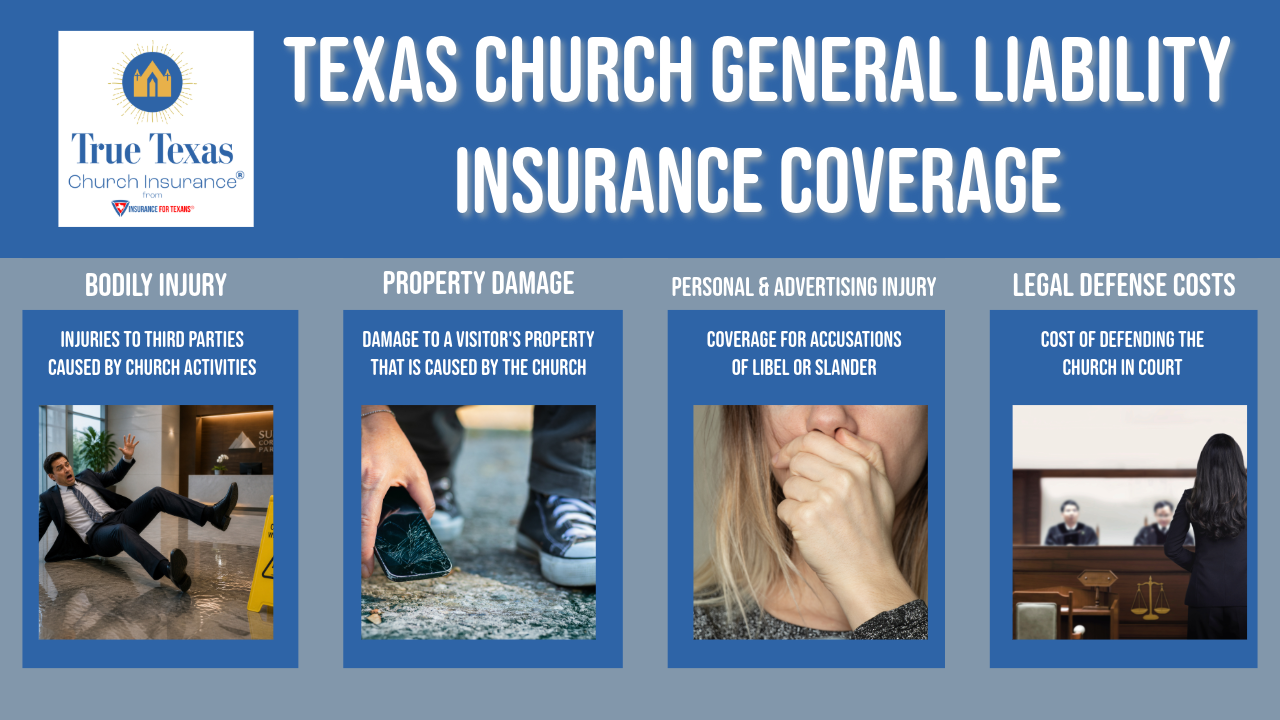
Bodily Injury

Bodily Injury coverage responds when a visitor, member, volunteer, or another third party is physically injured because of the church’s property or operations.

Common examples include someone slipping on a wet floor, falling on an uneven sidewalk, being struck by falling equipment, or getting hurt during a church-sponsored activity.

Depending on how the policy is written, it also pays legal defense costs, settlements, or judgments when the church is accused of causing the injury. Some policies also include a smaller Medical Payments limit that may pay certain immediate medical expenses without requiring the injured person to prove the church was negligent.

Property Damage

Property Damage coverage responds when the church, its employees, or its volunteers accidentally damage property belonging to someone else.

For example, church volunteers may damage a rented event venue while setting up equipment. 

General Liability does not normally pay for damage to the church’s own buildings or contents. That loss belongs under Church Property Insurance.

Personal and Advertising Injury

General Liability also covers certain claims involving personal and advertising injury. This can include allegations of libel, slander, wrongful eviction, or the improper use of another organization’s advertising idea.

This coverage has limits and exclusions. It should not be confused with Cyber Liability, Employment Practices Liability, or Directors and Officers coverage.

Legal Defense Costs

Even a weak or unfounded claim can be expensive to defend. The church may need an attorney to respond to subpoenas, gather records, interview witnesses, and represent the Church in court.

A General Liability policy may pay legal defense costs for a covered claim. Church leaders should confirm whether defense expenses are paid inside or outside the policy limits.

Understanding Your Liability Limits

General Liability policies include several limits that control how much the insurance company will pay in the event of a covered claim. 

Each Occurrence Limit

The Each Occurrence limit is the maximum the policy may pay for a single covered incident.

One accident may involve several injured people, multiple property damage claims, legal expenses, and a settlement. Those costs may all reduce the amount available under the occurrence limit, depending on the policy.

General Aggregate Limit

The General Aggregate is the maximum amount the policy pays for certain covered claims during the policy period.

A church could have several liability claims during the same year. Once the aggregate is exhausted, the church may be responsible for additional covered losses unless an Umbrella or Excess Liability policy applies.

Medical Payments Limit

Medical Payments coverage helps with medical expenses after someone is injured on church property or during a covered activity. It is designed to quickly cover the person's medical expenses in order to make them whole, but also to prevent a bigger lawsuit. It does not have a deductible. 

This limit is usually much lower than the main liability limit. It is not a substitute for Bodily Injury Liability coverage.

Damage to Premises Rented to You

This coverage is similarly structured to medical payments. It has its own sublimit is designed to pay when the church damages a building or space it rents. It does not cover property owned by the church.

Before renting a school auditorium, event center, office, or temporary worship space, Texas Church leaders should review this limit carefully. The property owner may require the church to carry a specific amount of coverage before signing the agreement.

Texas Church General Liability Insurance Website Image

Does General Liability Cover Every Ministry?

A policy written only around Sunday worship may not reflect everything your church does throughout the week.

Many Texas churches operate food pantries, private schools, Mother’s Day Out programs, counseling ministries, recovery groups, athletic programs, camps, community events, security teams, and transportation ministries.

Each activity changes the church’s liability exposure. More people, more volunteers, and more complex activities create more opportunities for injuries, property damage, and lawsuits.

That does not mean the church should stop serving people. It means that Texas Church leaders need to clearly define their ministry activities to their insurance agent and verify that their general liability policy provides coverage for each of them. 

This version explains the problem more directly and shows why the legal name matters:

Make Sure Every Legal Entity Is Named on the Policy

A church may operate a school, childcare center, foundation, food pantry, or outreach ministry under a separate legal name. Even when that organization uses the church’s property, staff, volunteers, and leadership, it may not automatically be covered by the church’s General Liability policy.

For example, the policy may name First Baptist Church as the insured, while the church-operated school is legally registered as First Baptist Christian Academy. If the academy is not listed on the policy and a claim arises from its operations, the insurance company may question whether that organization is covered.

Church leaders should identify the legal name of every organization connected to their church and confirm that each one is properly listed or added to the policy. Sharing the same campus, board members, or church name does not guarantee coverage.

Outside Groups Can Create Liability Gaps

Churches often allow community groups, support programs, schools, families, and other congregations to use their property.

A facility-use agreement should explain who is responsible for injuries, property damage, security, cleanup, and supervision. The outside organization should generally carry its own General Liability Insurance and provide proof of coverage.

When appropriate, the church may also require the outside organization to name it as an additional insured.

A Certificate of Insurance alone does not change the policy or create coverage that is not already included. Additional insured protection must come from the actual policy or endorsement.

The same principle applies to contractors, caterers, inflatable companies, security providers, and other vendors working at the church.

What Liabilities Require Separate Coverage?

General Liability is an important part of the insurance program, but it does not replace every other liability policy.

Employee Injuries

Injuries to paid employees are generally excluded from Commercial General Liability. Texas Workers’ Compensation Insurance is designed to address medical expenses and lost income after a covered workplace injury.

Church Vehicle Accidents

Claims involving church-owned vans, buses, trucks, and cars belong under Commercial Auto Insurance.

The church may also need Hired and Non-Owned Auto coverage when it rents vehicles or employees and volunteers use personal vehicles for church business.

Abuse and Molestation Claims

Sexual abuse, molestation, or misconduct claims may be excluded or severely limited under General Liability.

Churches serving children, youth, or vulnerable adults need dedicated Abuse and Molestation coverage with limits that reflect the seriousness of the exposure.

Pastoral Counseling Claims

General Liability is not designed to cover allegations that pastoral advice, counseling, or professional services caused emotional, financial, or personal harm.

Pastoral Counseling or Professional Liability coverage should be reviewed separately.

Employment Claims

Wrongful termination, discrimination, harassment, retaliation, and other workplace disputes generally require Employment Practices Liability Insurance.

A church’s religious status may provide certain legal protections, but it does not prevent an employee or applicant from making a claim.

Board and Leadership Decisions

Claims involving financial management, bylaws, governance, membership decisions, and the actions of pastors, elders, trustees, or board members require Directors and Officers Liability Insurance.

Cyber Incidents

Data breaches, ransomware, hacked email accounts, and stolen electronic funds require Cyber Liability and possibly Social Engineering Fraud coverage.

Damage to Church Property

General Liability does not replace Church Property Insurance. Damage to the sanctuary, classrooms, equipment, furniture, signs, or other property owned by the church should be addressed through property insurance.

Strong Liability Protection Starts Before the Claim

Insurance can help after an accident, but good risk management may prevent one from happening.

Churches should regularly inspect and maintain walkways, lighting, handrails, playgrounds, kitchens, classrooms, and other public areas. Leadership should also correct known hazards, document inspections, and use written procedures for reporting incidents.

Volunteer screening, child protection policies, food safety rules, transportation procedures, facility-use agreements, and event planning can further reduce risk. These steps cannot prevent every claim, but they show that leadership took reasonable precautions and provide important records if an accident is investigated.

Texas Churches Need a Liability Specialist

A general commercial agent may see a building where people gather once or twice a week. A church insurance specialist sees children’s ministries, counseling, outreach, volunteers, schools, food distribution, community events, facility rentals, and security teams operating under the same organization.

Those differences affect classifications, limits, exclusions, endorsements, and which insurance companies are willing to offer coverage.

True Texas Church Insurance works with multiple carriers that understand religious organizations. We help church leaders match the policy to the way their ministry actually operates instead of forcing the church into a generic commercial plan.

We provide more than a liability quote. We give church leaders practical risk management strategies to protect the people, activities, and financial resources that are important to their mission. 

Protect Your Texas Church

No church is immune from liability. Every visitor, volunteer, ministry program, community event, and outside organization creates another opportunity to serve, but it also creates another chance for someone to be injured, property to be damaged, or the church to face a lawsuit.

Do not wait until a claim exposes a limit, exclusion, or ministry activity that was never properly covered.

True Texas Church Insurance helps church leaders understand their General Liability coverage, uncover costly gaps, and protect the people, programs, and financial resources that keep their church moving forward. Through our personalized risk assessment, we replace assumptions with a clear liability protection strategy.

Click the button below to schedule a policy review with our church insurance experts.

Click To Cover Your Church!


True Texas Church Insurance Process

Step One: Understand the Full Risk

We begin by learning who uses the church property and what happens there throughout the week. This includes reviewing worship services, schools, childcare, counseling, events, volunteers, outside groups and security teams. We also review the current policy, loss history, limits, endorsements, exclusions, and every legal entity connected to your church's ministry activities.

Step Two: Build the Liability Strategy

Once we understand the church, we identify which risks fit within General Liability and which require separate coverage. We compare limits, aggregates, medical payments, additional insured requirements, defense provisions, and policy exclusions. We also consider whether Umbrella Liability is needed to provide higher limits if needed. Our goal is to balance premium, protection, and the amount of financial risk your church is prepared to keep.

Step Three: Present the Church to Insurance Companies

We take the time to tell your church’s full story to insurance underwriters. We explain who you serve, how your ministries operate, and the steps your leadership takes through volunteer screening, training, safety procedures, and written agreements to protect your people and property. Not every insurance company understands churches or evaluates them the same way. Our job is to find carriers that will protect your mission. 

Why Texas Churches Turn To True Texas Church Insurance

300+
Churches Trusted By True Texas Church Insurance
600+
Churches Helped In Some Way By True Texas Church Insurance
The Promise Of Certainty

We Wrote The Book On Texas Church Insurance

  • Real Stories About Texas Churches
  • Practical Advice For Church Leaders
  • Our Three Step Process
  • Why Coverage Matters
  • Your Guide To Certainty

What Texans Have To Say About Our Process

Are You Ready To Protect Your Church?