Skip to content
True Texas Church Insurance - Original

Texas Church Pastoral Liability Insurance

Pastoral Liability Insurance helps protect a church, its pastors, and other ministry leaders when someone claims that spiritual counseling, advice, or guidance caused emotional, personal, or financial harm. Depending on the policy, it may pay legal defense costs, settlements, and judgments arising from a covered counseling claim.

Pastoral Care Creates a Different Kind of Liability

People often turn to their pastor during the most difficult moments of their lives. They may need guidance through marriage problems, grief, addiction, financial stress, family conflict, or a personal crisis.

Those conversations are an important part of a church’s ministry activities. They also place pastors in a position of trust and influence.

A person may later claim that a pastor gave harmful advice, failed to recognize a serious problem, shared private information, or continued providing counseling that should have been referred to a licensed professional. The church may be named in the claim even when the church’s leaders believe that the pastor acted with compassion and good intentions.

The Counseling Relationship That Became a Lawsuit

A member of a Texas church began meeting with the senior pastor after experiencing serious problems in her marriage. The pastor listened, prayed with her, and offered spiritual guidance over several months.

As the situation became more complicated, the member began discussing depression, financial problems, and concerns about her husband’s behavior. The pastor continued meeting with her but did not clearly explain the limits of pastoral counseling or recommend that she seek help from a licensed mental health professional.

The marriage eventually ended. During the separation, the former member claimed that the pastor’s advice made the conflict worse and that private details from their conversations had been shared with another church leader.

She filed a claim against both the pastor and the church, alleging negligent counseling, emotional harm, and breach of confidentiality.

Church leadership believed the pastor had acted in good faith. But the church still needed an attorney to respond, review months of communications, interview leaders, and defend the church against the allegations. The cost of defending that accusation can be significant even when the church did nothing wrong.

What Does Pastoral Liability Insurance Cover?

Pastoral Liability Insurance is designed for claims arising from spiritual counseling. The exact protection depends on the policy, but it may respond to several common allegations.

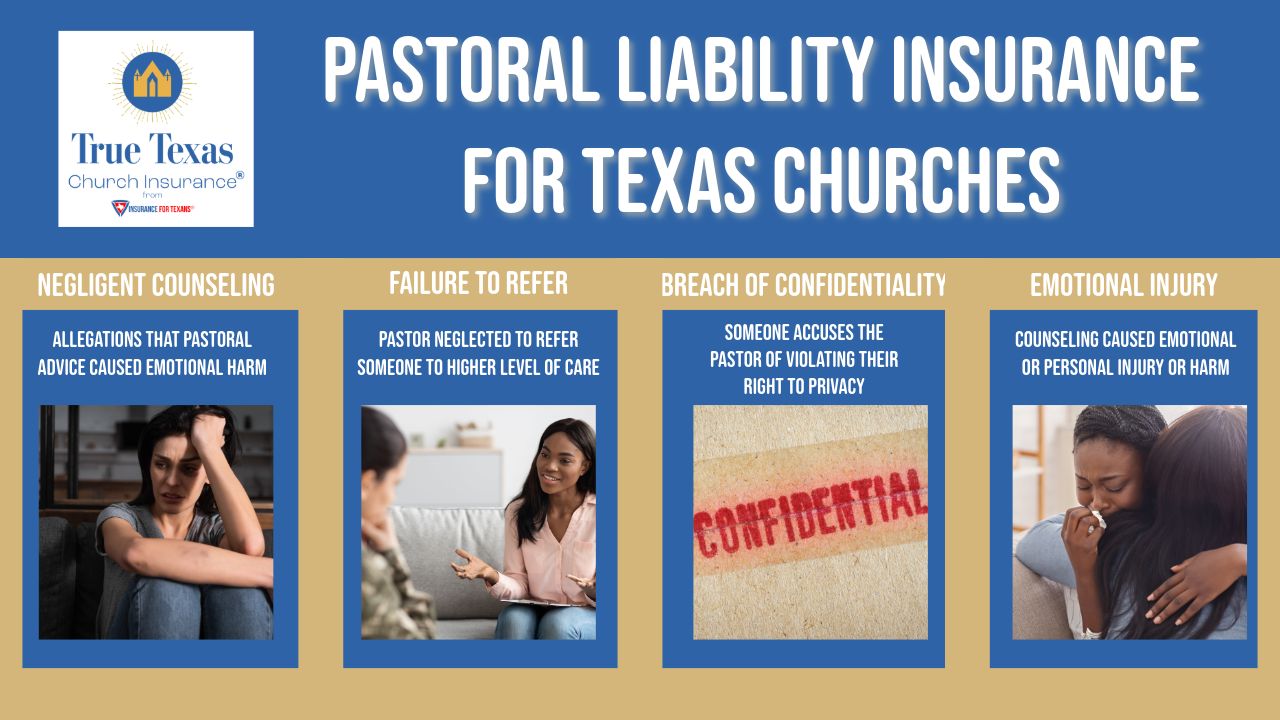
Negligent Counseling or Advice

A person may claim that a pastor or lay counselor gave advice that caused emotional, personal, marital, or financial harm.

For example, someone may allege that a pastor gave harmful marriage advice, mishandled a family crisis, or encouraged a decision without understanding the full situation.

The policy may help defend the church and counselor when the claim arises from covered counseling provided on the church’s behalf.

Failure to Refer

Pastors are often asked to help with problems that reach beyond spiritual guidance. A person may be dealing with severe depression, addiction, domestic violence, trauma, or another issue that requires professional treatment.

A claim may allege that the pastor continued counseling after the matter should have been referred to a licensed counselor, physician, attorney, or another qualified professional.

Pastors do not need to diagnose every problem. They do need to recognize the limits of their training and know when to refer to a professional.

Breach of Confidentiality

People commonly expect conversations with pastors to remain private. A claim may arise when someone believes sensitive information was shared without permission.

That could include details about a marriage, addiction, mental health, finances, family conflict, or another personal matter.

Pastors should never promise absolute confidentiality. Texas reporting laws and other legal duties may require information to be disclosed in certain situations.

Emotional or Personal Injury

Pastoral counseling claims may involve emotional distress, humiliation, damaged reputation, invasion of privacy, or other personal injuries that do not involve physical harm.

Coverage may protect the organization and certain pastors, employees, volunteers, and lay counselors from claims of bodily, emotional, or personal injury related to counseling performed on the organization’s behalf.

Legal Defense Costs

A counseling claim can become expensive before anyone determines whether the pastor or church was legally responsible.

The church may need an attorney to respond to a demand letter, gather records, prepare witnesses, and defend the claim in court. Depending on the policy, Pastoral Liability may pay those defense costs along with covered settlements or judgments.

Texas Church leaders should confirm whether defense expenses reduce the policy limit or are paid in addition to it.

Who May Be Protected by the Policy?

Pastoral counseling is not always provided by the senior pastor.

Churches may rely on associate pastors, ministry directors, staff members, volunteer counselors, elders, small-group leaders, or members of a prayer ministry to help people through difficult situations.

Depending on the policy, Pastoral Liability may protect:

  • The church as an organization
  • Pastors and ministerial staff
  • Employees providing spiritual counseling
  • Lay counselors
  • Approved volunteers
  • Directors, elders, or officers involved in counseling oversight

Coverage is not automatic for every person connected to the church. Texas church leaders should confirm who qualifies as an insured and whether volunteers or lay counselors must be approved, trained, or specifically included.
Pastoral Liability Insurance for Texas Churches Website Image-1

General Liability May Not Cover Counseling Claims

Church General Liability Insurance primarily responds to certain claims involving bodily injury, property damage, and personal or advertising injury.

A claim based on professional advice or counseling may fall under a professional services exclusion. Even when the person claims emotional harm, the General Liability policy may not respond because the alleged injury came from counseling rather than an accident on church property.

Pastoral Liability fills that gap by addressing claims connected to spiritual guidance and counseling services.

Church leaders should not assume this protection is automatically included. Some church packages include a limited counseling endorsement, while others require separate coverage.

Pastoral Liability Is Not Abuse and Molestation Coverage

Pastoral Liability and Abuse and Molestation coverage protect against different allegations.

Pastoral Liability generally addresses claims involving negligent spiritual counseling, advice, confidentiality, or professional mistakes.

Abuse and Molestation coverage addresses allegations of sexual abuse, molestation, grooming, or misconduct. These claims are commonly excluded from Pastoral Liability or handled under a separate coverage section.

A counseling relationship that becomes sexual or exploitative may create serious criminal and civil consequences. Texas law specifically addresses situations in which a member of the clergy exploits someone’s emotional dependency while acting as a spiritual adviser.

Churches need strong boundaries and separate Abuse and Molestation coverage. One policy should not be expected to replace the other.

Licensed Counselors Need Their Own Coverage

Some churches employ or contract with licensed professional counselors, marriage and family therapists, psychologists, or other mental health professionals.

These individuals provide services under professional licenses and standards that are different from ordinary pastoral counseling. They should maintain their own Professional Liability or Malpractice Insurance with limits appropriate for their practice.

The church should obtain proof of coverage from independent counselors and use written agreements explaining their relationship with the church.

The church’s Pastoral Liability policy may not cover licensed clinical services, services provided for a fee, or counseling performed outside the person’s role with the church.

Confidentiality Has Limits in Texas

Texas generally recognizes a privilege for confidential communications made to a pastor acting in the person’s professional role as a spiritual adviser.

That privilege is important, but it does not mean every conversation with a pastor can always remain secret. The details of the communication, the pastor’s role, who was present, and how the information was later used can all affect whether privilege applies.

Pastors should explain the limits of confidentiality before counseling begins. They should not promise that nothing discussed will ever be shared.

Mandatory Reporting Comes Before Confidentiality

Texas law requires suspected abuse, neglect, or exploitation involving children, older adults, and adults with disabilities to be reported.

That duty can apply even when the information is learned during an otherwise private conversation. Texas reporting guidance specifically states that reporting duties apply broadly. All adults are mandated reporters in the state of Texas.

A pastor should not conduct an internal investigation before making a required report. The church should have written procedures explaining:

  • Who must make the report
  • How quickly the report must be made
  • Which authorities must be contacted
  • Who within the church should be notified
  • How records and confidentiality should be handled

The church should have these procedures reviewed by a Texas attorney. Insurance does not replace the legal duty to report suspected abuse.

Common Exclusions:

Pastoral Liability Insurance does not cover every disagreement involving a pastor or church member.

Common exclusions or limitations may include:

  • Intentional or Criminal Acts: Insurance generally does not protect someone who knowingly commits fraud, abuse, assault, or another intentional criminal act.
  • Sexual Misconduct: Claims involving sexual abuse, molestation, grooming, or an inappropriate sexual relationship require separate Abuse and Molestation coverage.
  • Licensed Clinical Services: Counseling performed by a licensed professional requires separate Professional Liability or Malpractice Insurance.
  • Employment Disputes: Claims involving termination, discrimination, harassment, retaliation, or other workplace issues belong under Employment Practices Liability Insurance.
  • Leadership and Governance Decisions: Claims involving membership discipline, church governance, financial decisions, bylaws, or the actions of the board require Directors and Officers Liability coverage.
  • Known Circumstances: A church may not receive coverage for a counseling dispute that leadership knew about before the policy began.

Understand the Policy Limits

Church leaders should review:

  • The Pastoral Liability limit
  • Any separate aggregate limit
  • The deductible or retention
  • Whether defense costs reduce the limit
  • Who qualifies as an insured
  • Whether lay and volunteer counselors are covered
  • Whether online and telephone counseling are included
  • Whether prior counseling is covered
  • Whether licensed counseling is excluded
  • Whether an Umbrella policy applies over the coverage

Some church policies provide only a small sublimit for pastoral counseling. A low limit can be consumed quickly by attorney fees, leaving little money for a settlement or judgment.

Strong Counseling Practices Start Before the Claim

Pastoral Liability Insurance can help after someone makes an allegation. Written counseling practices may reduce the chance that a misunderstanding becomes a claim.

Churches should consider:

  • Defining the difference between spiritual guidance and professional therapy
  • Using a written counseling policy
  • Explaining confidentiality and its legal limits
  • Obtaining informed consent when appropriate
  • Establishing a referral network of licensed professionals
  • Screening and training anyone who provides counseling
  • Setting boundaries for communications and meeting locations
  • Avoiding isolated counseling sessions with minors
  • Keeping another adult present in the building
  • Protecting counseling notes and electronic communications
  • Creating procedures for emergencies and mandatory reports

Churches should also establish clear boundaries for counseling relationships. Meetings should occur in appropriate settings, and counseling should never develop into a secret personal or romantic relationship.

Texas Churches Need a Pastoral Liability Specialist

A general commercial agent may see counseling as a small part of the church’s operations. A church insurance specialist understands that spiritual guidance is one of the most personal and sensitive services that a Texas church provides.

The exposure can involve pastors, volunteers, confidentiality, mandated reporting, professional referrals, online communication, and separate licensed counseling programs.

Those details affect who is covered, how the policy defines counseling, which exclusions apply, and whether the limit will actually protect the church after a claim.

True Texas Church Insurance provides more than a Pastoral Liability quote. We help church leaders understand the counseling risk and develop practical strategies to protect the pastor, the person receiving care, and the church.

Protect Your People

People often seek pastoral care when they are vulnerable, confused, or hurting. That creates an opportunity for meaningful ministry, but it also places serious responsibility on the pastor and church.

Do not wait until a counseling complaint reveals that the church’s General Liability policy does not apply or that its Pastoral Liability limit is too small to pay the defense costs.

True Texas Church Insurance helps Texas church leaders understand their Pastoral Liability limits, exclusions, insured counselors, confidentiality risks, and related coverage needs. Through our personalized risk assessment, we replace assumptions with a clear strategy for protecting your pastoral team, the people they counsel, and the ministry they serve.

Click the button below to schedule a policy review with our church insurance experts.

Click To Cover Your Church!


True Texas Church Insurance Process

Step One: Understand the Counseling Ministry

We review who provides counseling, what type of guidance they offer, where sessions occur, and whether counseling is provided in person, by telephone, or online. We also look at licensed counselors, lay ministries, confidentiality practices, reporting procedures, referrals, and any counseling performed through a separate legal organization.

Step Two: Build the Pastoral Liability Strategy

We review the policy limit, deductible, defense provisions, insured people, exclusions, and whether prior counseling activities are covered. We also examine how Pastoral Liability works with other policies. Our goal is to help leadership understand which counseling risks are being transferred and which responsibilities the church still carries.

Step Three: Present the Church to Insurance Companies

We take the time to explain how your church provides pastoral care. We show underwriters the church’s written procedures, training, counseling boundaries, reporting practices, referral process, and other steps leadership takes to protect people. Not every insurance company understands pastoral counseling or evaluates it the same way. Our role is to find carriers that understand churches and explain the real differences between the coverage options they offer.

Why Texas Churches Turn To True Texas Church Insurance

300+
Churches Trusted By True Texas Church Insurance
600+
Churches Helped In Some Way By True Texas Church Insurance
The Promise Of Certainty

We Wrote The Book On Texas Church Insurance

  • Real Stories About Texas Churches
  • Practical Advice For Church Leaders
  • Our Three Step Process
  • Why Coverage Matters
  • Your Guide To Certainty

What Texans Have To Say About Our Process

Are You Ready To Protect Your Church?