Special Event Insurance provides short-term liability protection for a specific event. Depending on the policy, it covers injuries to guests, damage to the event venue, legal defense costs, and certain expenses caused by a covered cancellation or postponement.
The coverage may be written for a church-sponsored event or purchased by an outside group using church property. The event, dates, location, attendance, activities, and organizations involved must be described correctly for the policy to respond as expected.
Special Events Create Risks
Churches do more than hold worship services on Sunday mornings. Texas churches also focus on community outreach. Fall festivals, concerts, weddings, vacation Bible school and retreats are few of the many ways that churches reach the communities around them.
Insurance coverage for some of these activities fit within the church’s current policies. Others bring larger crowds, take place at unfamiliar locations, involve outside vendors or rented equipment and are therefore outside of the scope of the church’s policy.
Even if an event only lasts one evening, the church is liable for anything that could go wrong. Those financial consequences could last long after the event is over. That is why special event insurance exists. It fills in the gaps left by the church’s other policies.
Fall Festival Gone Wrong
A small church in west Texas decided that this was the year to host the biggest fall festival that their little community had ever seen. They decided to hold the event at a city park instead of in the church parking lot because they expected several hundred people to show up. The church hired food vendors, rented two inflatable attractions, arranged live music, and asked volunteers to help with parking and crowd control.
Everyone on the leadership team was thrilled by the number of people who showed up for the event.
But that all changed as the event continued into the early evening hours. A five year old child was bouncing with his friends and fell out of one of the inflatables. He landed with his arms stretched out to break his fall, but ended up breaking his arm instead. This not only resulted in a broken arm but also an ambulance ride, an emergency room visit and six weeks of follow up appointments with an orthopedic surgeon. The family was not prepared to pay for all of these expenses and had no choice but to sue both the inflatable company and the church for negligence.
Church leaders believed that the inflatable company’s insurance would handle everything. But they were wrong. They soon discovered that the rental agreement they signed placed significant responsibility and liability onto the church. The vendor’s policy had limitations that no one at the church had ever reviewed. The leaders also consulted with their own insurance agent and found out that this event was not covered under their general liability policy. The carrier denied it because it was off-site, involved inflatables and was not discussed with them prior to the event taking place.
The church was left to defend themselves in court and pay out a settlement that destroyed their church budget for several years. This is why special event insurance matters.
Does Every Church Event Need a Separate Policy?
Texas churches carry General Liability Insurance to protect the normal activities of an active congregation. Worship services, Bible studies, Sunday morning children’s programs, and small fellowship events are typically covered under the church’s existing policy.
The problem comes when Texas church leaders assume that every event receives that same protection. Larger crowds, off-site locations, outside vendors, or unusual activities can create risks that fall outside the church’s normal coverage.
These are the times that it is most important to have a trusted church insurance agent. Contacting your agent to discuss insurance coverage while you are in the planning stages of the event will eliminate a lot of headaches later.
What Does Special Event Liability Insurance Cover?
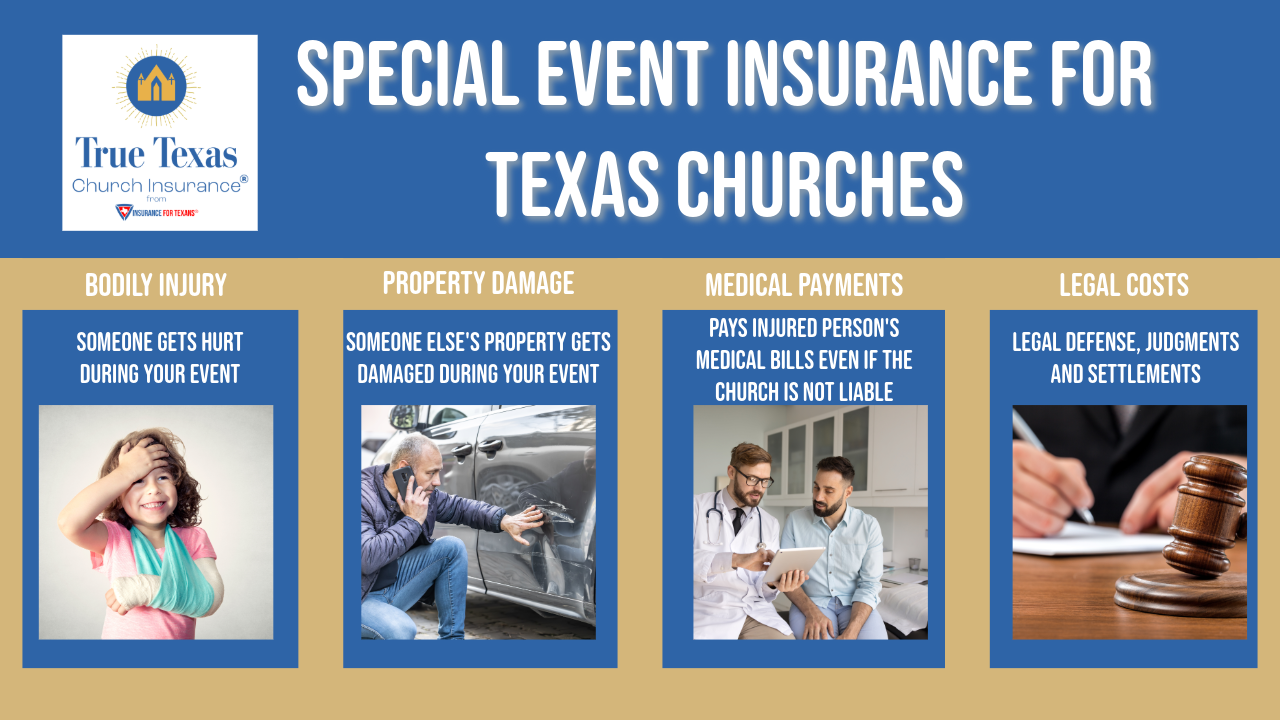
Special Event Liability Insurance primarily addresses claims involving injuries or property damage caused by the event.
Bodily Injury
Special Event Liability Insurance is designed to cover third-party bodily injury claims that arise during the event. For example, a guest may slip on a wet floor, trip over an extension cord, or fall from temporary seating.
If the church is found legally responsible for the injury, the Special Event policy helps pay the related medical costs, legal defense expenses, and covered damages.
Property Damage
Special Event Liability Insurance can also cover damage the church causes to property during an event. This may include a rented auditorium, park facility, hotel ballroom, community center, or another venue.
If the church is legally responsible for the damage, the policy helps pay the repair or replacement costs. Church leaders should also review the damage-to-rented-premises limit because it may be lower than the main liability limit.
Legal Defense Costs
A church may need an attorney even when it believes it did nothing wrong. Special Event Liability Insurance helps pay the cost of responding to a claim and defending the church in court.
Church leaders should know whether defense costs are paid in addition to the policy limit or reduce the amount available for a settlement or judgment.
Medical Payments
Some event policies provide a limited amount for immediate medical expenses after a guest is injured.
Medical Payments coverage may apply without first requiring the guest to prove the church was negligent. It is not a substitute for a full liability limit and may exclude participants in athletic or higher-risk activities.
Additional Insured Protection
An off-site venue may require the church to name the property owner, city, school, hotel, or event center as an additional insured.
A Certificate of Insurance shows that a policy exists. The additional insured endorsement is what actually changes the policy to provide the requested protection.
Church-Sponsored Events vs. Outside Events
Special Event Insurance can apply in two very different situations.
The Church Sponsors the Event
When the church plans and controls the event, Texas church leaders should first determine whether their existing church policy covers the activity. If the event falls outside the carrier’s normal guidelines, the church may need an endorsement or a separate Special Event policy.
The policy should reflect the correct location, dates, setup and cleanup periods, expected attendance, activities, vendors, and organizations involved.
An Outside Group Uses Church Property
Churches frequently allow members, community groups, schools, and private individuals to use their facilities. The fact that an event happens inside the church does not mean that it is automatically covered by the church’s insurance policy. Most often, the outside user needs to provide its own liability insurance and name the church as an additional insured.
Weddings and Private Celebrations at the Church
Weddings, receptions, birthday parties, and other private events may be held at the church without being sponsored by the church. In those cases, the organizer should purchase a one-day Special Event Liability policy that names the church as an additional insured.
The church also needs a written facility agreement that explais:
- Which rooms may be used
- Setup and cleanup responsibilities
- Decorations and candle restrictions
- Food preparation rules
- Security requirements
- Child supervision
- Property damage responsibilities
- Required insurance
- Cancellation procedures
Special event policies may also offer optional cancellation coverage for nonrecoverable expenses caused by certain covered circumstances, such as a venue problem, vendor failure, severe weather, or sudden illness.
Outside Vendors Need Their Own Insurance
Food trucks, caterers, inflatable companies, musicians, and other vendors create risks the church does not control. Each vendor should carry the insurance needed for its work and provide a Certificate of Insurance before the event.
When appropriate, the vendor should also name the church as an additional insured. The contract should clearly state who is responsible for setup, supervision, safety, and equipment.