Skip to content
True Texas Church Insurance - Original

Workers' Compensation for Texas Churches

Workers’ Compensation Insurance provides the money for medical care as well as income benefits to employees who suffer a work-related injury or illness. This insurance also provides burial expenses and financial benefits to an employee’s family after a work-related death.

Protecting the People Who Serve Your Church

Church employees spend their days caring for people, managing ministries, maintaining buildings, teaching children, preparing meals, and helping the church to operate.

Ministry work may not seem dangerous, but there is always the possibility that injuries can occur. For example, a custodian could fall from a ladder while changing lights. A childcare worker could hurt her back while lifting a child. A pastor can be injured while driving to visit a member who is in the hospital. The outreach minister could slip and fall while setting up tables for an event.

Workers’ Compensation gives an injured employee a defined process receive medical care and replace part of the income lost while unable to work. It also helps protect the church from the financial and legal consequences of a workplace injury.

The Fall That Became the Church’s Responsibility

A small Texas church asked its part-time custodian to replace several burned-out lights in the sanctuary. While standing on a ladder, he lost his balance and fell onto the concrete floor.

The injury required surgery, physical therapy, and several months away from work.

Church leaders assumed their General Liability policy would pay the medical bills because the accident happened on church property. They soon discovered that General Liability normally excludes injuries to the church’s own employees.

Because the church had chosen not to carry Workers’ Compensation, the custodian could pursue a negligence claim directly against the church. Leadership now faced legal expenses, medical costs, lost wages, and the possibility of a judgment paid from church funds.

One workplace accident became a financial threat to the church's entire mission.

What Does Workers’ Compensation Cover?

A Texas Workers’ Compensation policy provides several types of benefits after a covered work-related injury or illness.

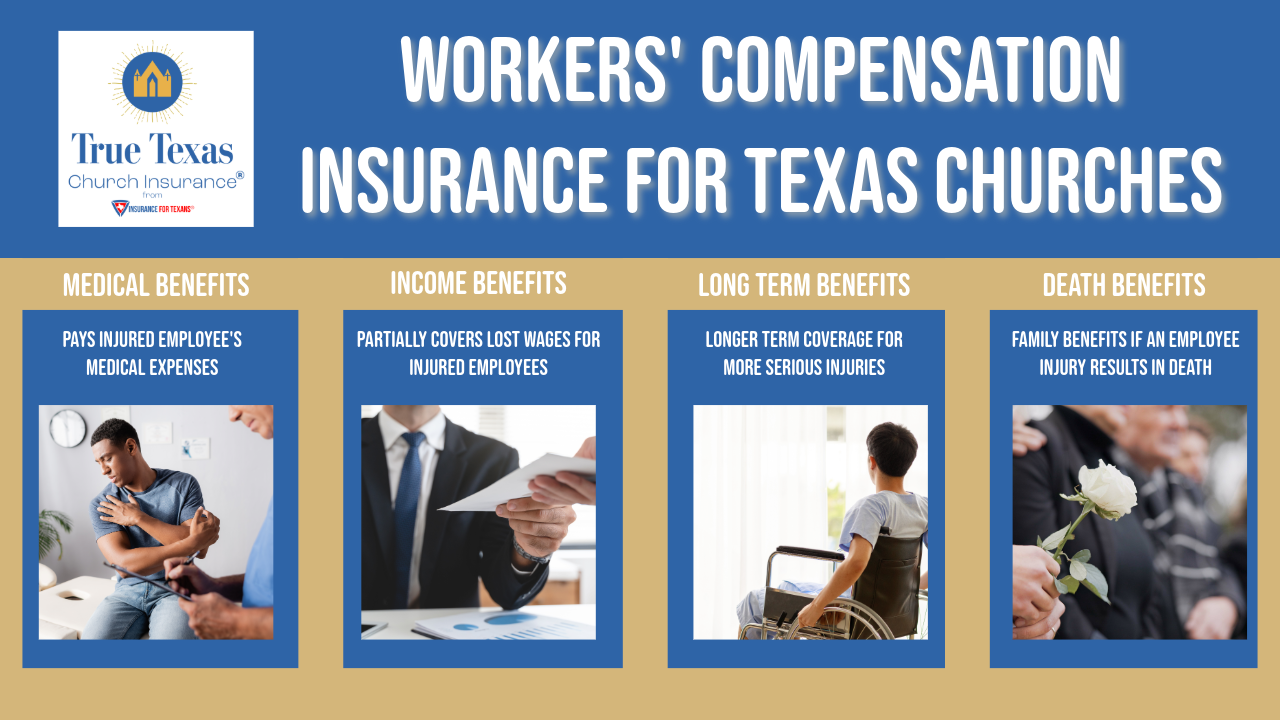
Medical Benefits

Medical benefits pay for reasonable and necessary treatment required to treat a work-related injury or illness. This may include emergency care, doctor visits, surgery, physical therapy, prescriptions, and other approved treatment.

The insurance carrier generally pays approved medical providers directly. The employee may be required to use a doctor within an approved Workers’ Compensation health care network.

Income Benefits

An employee who cannot work or cannot earn the same wages because of an injury may qualify for income benefits. These benefits replace part of the income the employee loses while recovering.

Texas provides several types of income benefits depending on the seriousness and duration of the injury. Workers’ Compensation does not necessarily replace every dollar the employee earned before the accident.

Impairment and Long-Term Benefits

Some injuries leave an employee with a lasting physical impairment or permanently reduce the person’s ability to work.

Depending on the injury, the employee may qualify for impairment, supplemental, or lifetime income benefits under Texas law.

Death and Burial Benefits

When an employee dies because of a work-related injury or illness, Workers’ Compensation pays part of the burial expenses and provides continuing financial benefits to qualifying family members.

Employers Liability Is Part of the Policy

A standard Workers’ Compensation policy also includes Employers Liability coverage. Workers’ Compensation benefits address injuries handled through the state system, while Employers Liability may respond to certain employee injury lawsuits that fall outside those statutory benefits.

These two protections work together, but they are not unlimited. Church leaders should review the Employers Liability limits and understand whether an Umbrella policy can provide additional limits over that part of the policy.

Are Texas Churches Required to Carry Workers’ Compensation?

Texas does not require most private employers, including churches, to purchase Workers’ Compensation Insurance. An employer that provides coverage is called a subscriber. An employer that does not provide coverage is called a non-subscriber.

That choice is sometimes described as an opportunity to save money. In reality, the church is deciding who will carry the financial risk when an employee is injured.

A subscriber transfers much of that risk to the Workers’ Compensation system. A non-subscriber keeps the risk and may have to defend itself in court.

Subscriber Versus Non-Subscriber

The difference between carrying Workers’ Compensation and going without it reaches far beyond the annual premium.

Subscriber: The Church Carries Coverage

A church with a Texas Workers’ Compensation policy is considered a subscriber. When an employee suffers a covered work-related injury or illness, the insurance company manages the claim and pays benefits available through the state system.

The church also receives an important legal protection commonly called the exclusive remedy. In most cases, the injured employee receives Workers’ Compensation benefits instead of suing the church for damages. Texas law includes limited exceptions, including certain fatal claims involving gross negligence.

This arrangement gives the employee access to a defined benefit system while helping protect the church’s operating funds, reserves, and ministry budget.

Non-Subscriber: The Church Does Not Carry Coverage

A church without Workers’ Compensation is a non-subscriber. If an employee is injured because of the church’s alleged negligence, that employee may sue the church in civil court.

Texas law also removes several defenses normally available to employers. A non-subscriber generally cannot defend the lawsuit by arguing that the employee contributed to the accident, accepted the risk, or was injured because of a co-worker’s negligence. The employee must still prove the church was negligent, but the church enters the lawsuit with fewer legal protections.

Non-subscribers also have notice and reporting responsibilities. They must notify employees that coverage is not provided, report their non-subscriber status to the state, and report certain workplace injuries, illnesses, and deaths.

Skipping Workers’ Compensation does not make the workplace injury disappear. It makes the church responsible for managing the injury and defending the lawsuit.


Workers compensation for Texas Churches Website Image

General Liability Does Not Replace Workers’ Compensation

General Liability Insurance is designed mainly for injuries to members, visitors, vendors, and other people who are not employees of the church. Employee injuries are commonly excluded. 

Workers’ Compensation Insurance exists specifically to address work-related injuries and illnesses involving employees. Relying on General Liability as a substitute will leave a church with no coverage when the claim occurs.

An Accident Policy Is Not the Same Coverage

Some churches purchase a limited accident policy and assume it takes the place of Workers’ Compensation.

An accident policy may pay a set amount for certain medical expenses. However, it provides low limits, short benefit periods, exclusions, and fixed payment schedules that do not reflect the full cost of a serious injury.

It also does not give the church the same subscriber protections provided by a Texas Workers’ Compensation policy. Alternative benefit plans may leave the church responsible when the employee’s medical costs and lost wages exceed the plan limits. 

Accident coverage can be useful for volunteers, participants, and certain ministry activities. It should not automatically be treated as a replacement for Workers’ Compensation.

How Employee Classifications Affect Workers’ Compensation

Workers’ Compensation classifications are based on the work each employee actually performs, not simply their job title. A pastor, office administrator, teacher, custodian, driver, and maintenance employee may all have different classifications because their duties create different levels of injury risk.

Those classifications affect the church’s premium, while reported wages help determine the income benefits an injured employee may receive. Incorrect classifications or payroll reporting can lead to unexpected audit charges and problems when a claim occurs, so the policy should accurately reflect each employee’s duties and compensation.

Do Volunteers Have Workers’ Compensation Coverage?

Workers’ Compensation is built around employees and reported payroll. Church leaders should not assume that unpaid volunteers are automatically covered by the policy.

A church may need Volunteer Accident or Participant Accident coverage for people serving without pay. That coverage may provide limited medical benefits when a volunteer is injured during an approved church activity.

The church should also discuss workers who receive stipends, housing, gifts, or other compensation with its agent. Calling someone a volunteer does not always settle how the person will be treated after an injury.

Church Employees Face Real Workplace Risks

Churches may feel safer than construction companies or factories, but employees still perform physical work throughout the week.

Custodians climb ladders, move furniture, use chemicals, and work around electrical equipment. Childcare employees lift children and work near playground equipment. Kitchen staff use hot surfaces, heavy containers, and sharp tools.

Pastors and ministry employees travel to hospitals, homes, conferences, and community events. Maintenance teams work on roofs, air-conditioning systems, landscaping equipment, and church vehicles.

The purpose of Workers’ Compensation is not to suggest that the church is unsafe. It is to recognize that even careful employees can suffer serious injuries while working for the church.

Policy Exclusions

Workers’ Compensation does not cover every injury involving an employee.

Texas guidance identifies several situations that do not qualify for benefits:

  • Injuries intentionally caused by the employee 

  • Injuries caused by intoxication or horseplay

  • Injuries occurring outside work

  • Injuries suffered during voluntary off-duty social or athletic events

  • Personal disputes unrelated to the job and certain acts of God may also fall outside coverage. 

Whether an injury is covered depends on the facts and whether it occurred within the course and scope of employment. The church should report possible workplace injuries promptly and allow the carrier to investigate instead of making its own coverage decision.

Payroll and Job Classifications Matter

Workers’ Compensation premium begins with estimated payroll and the classifications assigned to the church’s employees.

Higher-risk duties usually cost more to insure than office or clerical work. A custodian who performs maintenance and climbs ladders should not be classified the same way as an administrative assistant who works at a desk.

The policy is normally audited after the coverage period. The insurance company compares the estimated payroll and job duties with the church’s actual records.

Incomplete payroll, incorrect classifications, or undisclosed operations can lead to a large additional premium after the audit. Church leaders should review payroll records, employee duties, related entities, and new ministry programs throughout the year rather than waiting until the audit arrives.

Strong Employee Protection Starts Before the Injury

Workers’ Compensation can help after an employee is hurt, but good safety practices may prevent the injury from happening.

Churches should train employees for the work they perform, provide proper equipment, inspect ladders and tools, maintain clear walkways, and correct known hazards. Texas Church leaders should also document incidents and create a process for reporting injuries quickly.

Job descriptions should clearly identify physical responsibilities such as driving, lifting, maintenance, food preparation, childcare, and work at elevated heights.

These steps do not eliminate every accident. They help protect employees, provide useful documentation, and show that church leadership takes workplace safety seriously.

Texas Churches Need a Workers’ Compensation Specialist

A general commercial agent may see one payroll number and a list of employees. A church insurance specialist understands that a pastor, preschool teacher, custodian, office employee, driver, and maintenance worker all perform very different jobs.

Those differences affect classifications, payroll reporting, coverage, premium, and how the church should be presented to insurance companies.

True Texas Church Insurance works with multiple carriers that provide Workers’ Compensation coverage in Texas. We help church leaders understand the legal choice they are making and build protection around the employees who keep the ministry moving.

We provide more than a Workers’ Compensation quote. We give church leaders practical risk management strategies to protect their employees, finances, and ability to continue serving.

Protect Your Church's Mission

Your church depends on employees who show up each week to teach, lead, maintain the property, care for children, manage finances, and serve people.

Do not wait until an injury reveals that General Liability did not apply or that a limited accident plan was never enough.

True Texas Church Insurance helps Texas church leaders understand their Workers’ Compensation options, employee classifications, payroll, Employers Liability limits, and non-subscriber exposure. Through our personalized risk assessment, we replace assumptions with a clear strategy for protecting both the employee and the ministry.

Click the button below to schedule a policy review with our church insurance experts.

Click To Cover Your Church!


True Texas Church Insurance Process

Step One: Understand the Employees and Their Work

We review the church’s employees, payroll, job duties, related organizations, claims history, and daily operations. We also look at church-operated schools, childcare programs, transportation, maintenance, food service, counseling, and other ministries that may change the workplace risk.

Step Two: Build the Workers’ Compensation Strategy

We determine which employees and entities should be included and help the church understand subscriber and non-subscriber risk. We review classifications, payroll estimates, Employers Liability limits, audit procedures, and how the policy works with General Liability, Umbrella, Commercial Auto, and Volunteer Accident coverage. Our goal is to reduce the church’s Total Cost of Risk while providing a dependable process for caring for injured employees.

Step Three: Present the Church to Insurance Companies

We take the time to tell your church’s full story to insurance underwriters. We explain the work your employees perform, the ministries they support, and the steps leadership takes through training, written procedures, maintenance, and safety practices to reduce injuries. Not every insurance company evaluates churches the same way. Our job is to find carriers that understand church employment and compare the real differences between the available options.

Why Texas Churches Turn To True Texas Church Insurance

300+
Churches Trusted By True Texas Church Insurance
600+
Churches Helped In Some Way By True Texas Church Insurance
The Promise Of Certainty

We Wrote The Book On Texas Church Insurance

  • Real Stories About Texas Churches
  • Practical Advice For Church Leaders
  • Our Three Step Process
  • Why Coverage Matters
  • Your Guide To Certainty

What Texans Have To Say About Our Process

Are You Ready To Protect Your Church?